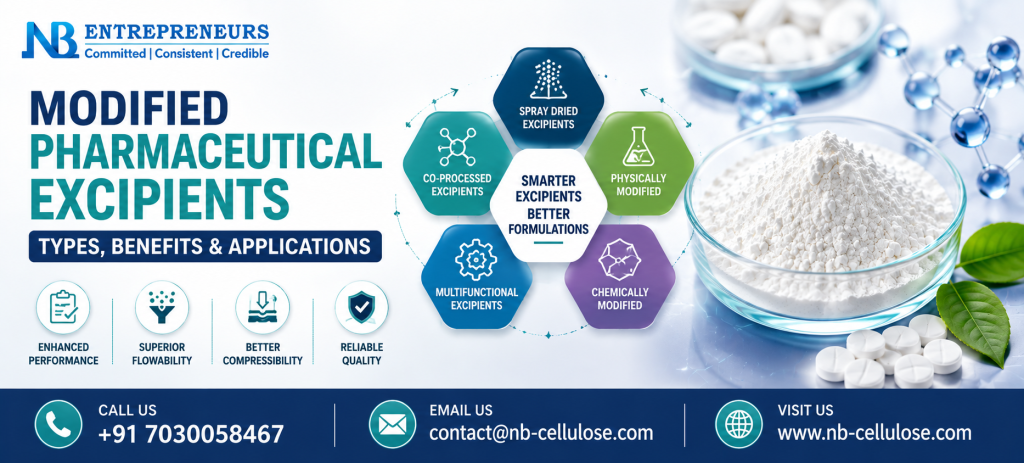
Modified Pharmaceutical Excipients: Types, Benefits & Applications
Modified pharmaceutical excipients are excipients whose physical, chemical, or processing characteristics have been intentionally altered to improve functionality in pharmaceutical formulations. Depending on the modification approach, they can offer improved flowability, compressibility, compactibility, particle-size control, porosity, surface properties, or drug-release characteristics.
Modified excipients can include spray-dried excipients, physically modified excipients, chemically modified excipients, and co-processed or multifunctional excipients. These materials are increasingly important in modern formulation development, particularly for direct compression, challenging APIs, controlled drug delivery, and formulations requiring improved manufacturing performance.
In this guide, we explain the types, modification techniques, benefits, and pharmaceutical applications of modified excipients, along with how they can support tablet manufacturing and drug-delivery performance.
What Are Modified Pharmaceutical Excipients?
Modified pharmaceutical excipients are conventional excipients that have been physically, chemically, or technologically modified to improve one or more functional properties such as flowability, compressibility, particle size, porosity, surface area, stability, or drug-release performance.
Why Are Pharmaceutical Excipients Modified?
Conventional excipients may not always provide all the functional properties required for modern formulation and manufacturing processes. Modification can help tailor an excipient to a specific application.
Key objectives include:
- Improving powder flowability
- Enhancing compressibility and compactibility
- Supporting direct compression
- Controlling particle size and morphology
- Improving formulation uniformity
- Modifying dissolution or drug-release behavior
- Combining multiple excipient functions
The goal is not simply to create a “better” excipient, but to achieve the functionality required for a specific formulation and manufacturing process.
Types of Modified Pharmaceutical Excipients
Modified excipients can be broadly classified according to how their functionality is changed:
- Physically modified excipients – particle size, shape, density, or morphology are modified.
- Spray-dried excipients – spray drying is used to engineer particle characteristics and powder performance.
- Co-processed excipients – two or more excipients are processed together to achieve complementary functionality.
- Chemically modified excipients – chemical structure or functional groups are intentionally altered.
- Multifunctional excipients – designed or processed to provide multiple formulation benefits.
Physical Modification of Pharmaceutical Excipients
Physical modification changes an excipient’s physical characteristics without necessarily changing its chemical identity.
Depending on the technique, modification may influence:
- Particle size distribution
- Particle morphology
- Bulk density
- Porosity
- Surface area
- Flowability
- Compressibility
Techniques may include milling, sieving, granulation, spray drying, agglomeration, and other particle-engineering approaches.
Spray-Dried Pharmaceutical Excipients
Spray drying is a particle-engineering technique used to convert a liquid feed, such as a solution, suspension, emulsion, or dispersion, into dry particles. In pharmaceutical excipient development, spray drying can be used to modify particle size, morphology, density, flow properties, and other functional characteristics.
Depending on the formulation and process conditions, spray drying can produce powders with different particle structures and performance characteristics. These properties can influence powder flow, compaction, dissolution, and processing behaviour.
Spray drying can be viewed as a constant procedure, hence diminishing time-to-market as a result of scale-up advantages and better quality. The pharmaceutical and biotech industry uses the spray drying process to create (co-processed) excipients. Spray drying is used to enhance the compactability of medications and to perform microencapsulation, granulation and complex arrangement.
This strategy empowers the change of feed from a liquid state into the dried particulate form by showering the feed into a hot drying medium. It is a continuous molecule handling drying activity. The feed can be an answer, suspension, scattering or emulsion. The dried product can be in the form of powders, granules or agglomerates depending on the physical and chemical properties of the feed, the dryer design, and the desired powder properties. This includes five stages:
- Concentration
- Automization
- Droplet-air contact
- Droplet drying
- Separation
Key Benefits of Spray-Dried Excipients
| Property | Potential Benefit |
|---|---|
| Particle-size control | Improved powder handling |
| Particle morphology | Better flow and packing |
| Porosity | Can influence compaction and dissolution |
| Density | Supports formulation and processing control |
| Surface characteristics | Can influence particle interactions |
| Process scalability | Supports commercial manufacturing |
Multifunctional Pharmaceutical Excipients
Multifunctional excipients are designed or processed to provide more than one functional benefit in a pharmaceutical formulation. Instead of relying on separate excipients for individual functions, a multifunctional excipient may combine properties such as binding, dilution, flow enhancement, and compression performance.
Multifunctional excipients are a class of excipients that incorporates pre-processed, what’s more, co-processed excipients that give added functionalities to the formulation (for instance, Silicified MicroCrystalline Cellulose, which is a handled mix of MCC and colloidal silicon dioxide). These functionalities incorporate:
Examples of functionality
- Flowability
- Compressibility
- Compactibility
- Binding
- Particle-size control
- Porosity
- Moisture management
- Tabletability
Multifunctional excipients can be acquired by building up another excipient (for example, cross-linked polymers) or by growing new evaluations of existing excipients; adjustment in the preparing prompts changes in the molecule measure dissemination, molecule shape and morphology, and porosity. Generally, industry avoids developing a new excipient, because of the cost included and regulatory issues. The adjustment in the production procedure of an excipient with some minor changes results in a product that has improved physical attributes prompting enhanced functionality.
Joining of known excipients at the sub-molecular level (otherwise called co-processing) prompts excipients with changed properties like upgraded surface area, expanded porosity, improved compressibility, great flowability and so on.
What Are Co-Processed Excipients?
Co-processed excipients are combinations of two or more established excipient materials processed together to provide improved or complementary functionality without forming anew chemical entity.
Benefits
- Improved flowability
- Better compressibility
- Improved compactibility
- Enhanced tabletability
- Reduced formulation complexity
- Better direct-compression performance
Co-processed excipients are likewise suitable for direct compression and, in this manner, help in the improvement of Tablet Processing. The explanation behind improved compressibility can be drawn from the fact that most co-processed excipients consist of a large amount of fragile material and a small amount of plastic material. In this manner, a co-processed material shows the property of being a mix of pliancy and fragility.
Co-Processed vs Conventional Excipients
| Feature | Conventional Excipient | Co-Processed Excipient |
|---|---|---|
| Functionality | Usually more specific | Can provide multiple functions |
| Flowability | Grade dependent | Can be engineered |
| Compressibility | Grade dependent | Can be enhanced |
| Direct compression | Application dependent | Often designed for DC applications |
| Formulation flexibility | Moderate | Potentially higher |
Co-processing does not automatically make an excipient superior. Its value depends on whether the resulting functionality addresses the requirements of the specific formulation.
Silicified Microcrystalline Cellulose as a Co-Processed Excipient
Silicified microcrystalline cellulose (SMCC) is a co-processed excipient combining microcrystalline cellulose with colloidal silicon dioxide. This combination is designed to provide the binding and compaction characteristics associated with MCC while supporting improved powder-flow and processing properties.
Modified Excipients for Direct Compression
Direct compression places greater importance on excipient functionality because the powder blend moves directly to compression without a conventional granulation step. Therefore, properties such as flowability, compressibility, compactibility, particle size, density, and tabletability become particularly important.
Want to Understand MCC in Direct Compression?
Microcrystalline cellulose is one of the most widely used excipients for direct-compression tablets. Learn how MCC tabletability, particle size, moisture, density, and other critical material attributes influence formulation performance within a QbD framework.
→ Read: Microcrystalline Cellulose in Direct Compression: Essential QbD Guide
Key Functional Properties of Modified Excipients
The performance of a modified excipient depends on its physical and functional characteristics.
Important properties include:
- Particle size and distribution
- Particle morphology
- Bulk and tapped density
- Specific surface area
- Porosity
- Moisture content
- Flowability
- Compressibility
- Compactibility
- Tabletability
These attributes can influence powder handling, tablet formation, mechanical strength, disintegration, and dissolution.
Modified Excipients and Quality by Design
A Quality by Design (QbD) approach helps pharmaceutical developers understand how excipient properties and manufacturing conditions influence product quality.
A simplified framework is:
Critical Material Attributes (CMAs)
↓
Critical Process Parameters (CPPs)
↓
Critical Quality Attributes (CQAs)
For modified excipients, potential CMAs may include:
- Particle size
- Moisture
- Density
- Surface area
- Porosity
- Morphology
The relevant attributes should be identified based on the specific formulation and intended product performance rather than assuming that every attribute is critical.
Modified Excipients in Drug Delivery Systems
Modified excipients can play an important role in designing dosage forms with specific performance requirements.
Depending on their properties, they may support:
- Immediate-release formulations
- Modified-release systems
- Controlled drug release
- Improved dissolution
- Enhanced powder processing
- Improved formulation stability
- Targeted or specialized delivery approaches
However, the performance of a modified excipient depends on the API, dosage form, formulation composition, processing method, and intended release profile.
Modified vs Conventional Excipients
| Feature | Conventional Excipient | Modified Excipient |
|---|---|---|
| Functionality | Standard | Enhanced/optimized |
| Particle properties | Naturally occurring/process-dependent | Intentionally engineered |
| Flowability | Grade dependent | Can be optimized |
| Compressibility | Grade dependent | Can be enhanced |
| Particle morphology | Conventional | Can be modified |
| Porosity | Standard | Can be engineered |
| Formulation flexibility | Moderate | Potentially higher |
| Direct compression | Grade dependent | Suitable for selected applications |
How to Select the Right Modified Pharmaceutical Excipient
The right modified excipient should be selected based on the formulation’s functional requirements, not simply because it offers more features.
Consider:
- API properties – solubility, dose, flowability, and compressibility
- Dosage form – tablet, capsule, modified-release system, etc.
- Manufacturing process – direct compression, granulation, coating, or another process
- Required functionality – flow, binding, compression, dissolution, or release control
- Excipient compatibility
- Regulatory and compendial requirements
- Batch-to-batch consistency and supplier quality
A well-selected modified excipient should solve a specific formulation or manufacturing challenge while maintaining consistent quality and regulatory suitability.
Looking for the Right Pharmaceutical Excipient?
Explore NB Entrepreneurs range of pharmaceutical excipients designed to support modern formulation and tablet-manufacturing requirements.
→ Explore Our Pharmaceutical Excipients
Need help identifying the right excipient for your formulation?
→ Contact Our Technical Team
Call: +91 7030058467
Email: contact@nb-cellulose.com

