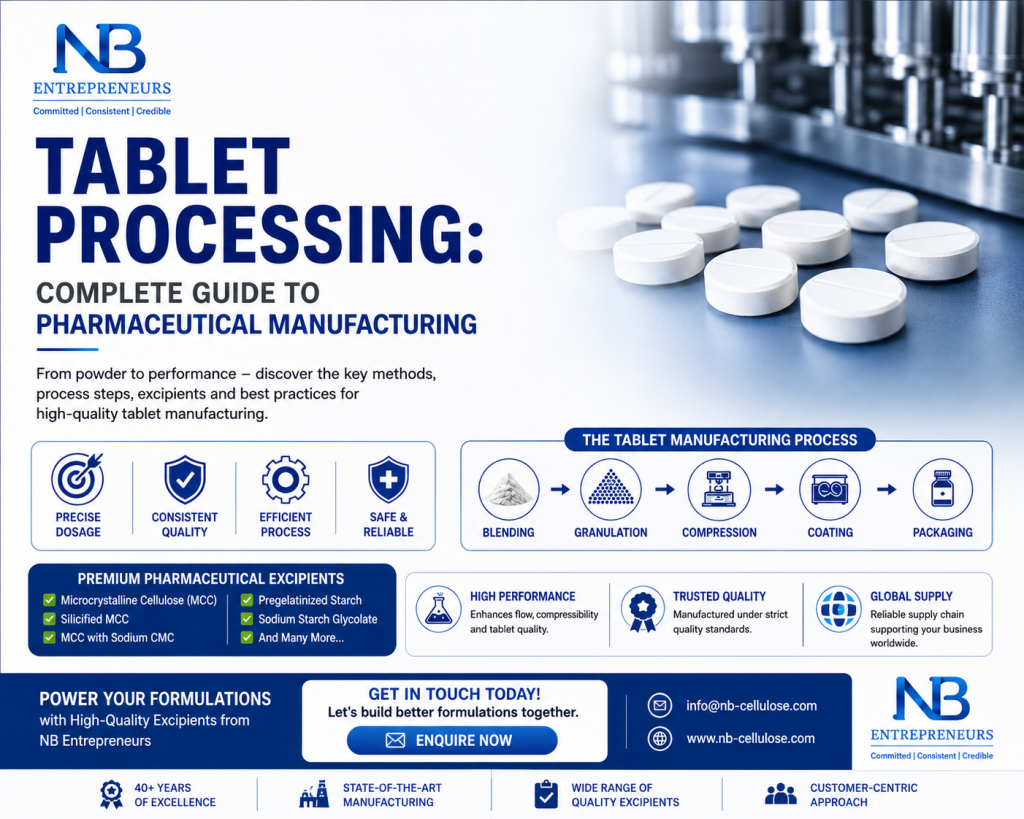
Tablet Processing: Complete Guide to Pharmaceutical Manufacturing
Tablet processing is the pharmaceutical manufacturing process of converting powdered or granulated ingredients into high-quality tablets. It plays a vital role in ensuring tablets meet the required standards for strength, stability, uniformity, and patient safety. From selecting the right excipients to choosing the appropriate manufacturing method, every step influences the final product’s quality and performance.
As the pharmaceutical industry continues to evolve, manufacturers rely on advanced tablet processing techniques to improve production efficiency, reduce costs, and deliver consistent dosage forms. In this guide, you’ll learn everything about tablet processing, its methods, key stages, challenges, and the role of pharmaceutical excipients in producing high-quality tablets.
What Is Tablet Processing?
Tablet processing is the systematic process of blending active pharmaceutical ingredients (APIs) with pharmaceutical excipients and compressing them into tablets. The objective is to produce tablets that have uniform weight, accurate dosage, sufficient hardness, rapid disintegration when required, and long-term stability.
A successful tablet processing operation depends on several factors, including powder flowability, compressibility, particle size distribution, moisture content, equipment performance, and formulation design.
Why Is Tablet Processing Important?
Tablet processing is essential because it directly affects the quality and effectiveness of pharmaceutical products. Proper processing ensures:
- Accurate and uniform dosage in every tablet
- Excellent mechanical strength and durability
- Improved stability during storage and transportation
- Consistent drug release and bioavailability
- Better patient compliance due to ease of administration
- Cost-effective large-scale manufacturing
Efficient tablet processing also minimizes production errors, reduces material wastage, and helps manufacturers comply with regulatory quality standards.
Looking for premium pharmaceutical excipients for your tablet formulations?
Partner with NB Entrepreneurs for high-quality, reliable excipients trusted by pharmaceutical manufacturers worldwide.
Contact us: +91 7030058467 | 📧 info@nb-cellulose.com
Major Methods of Tablet Processing
The choice of tablet processing method depends on the characteristics of the active ingredient and the formulation requirements.
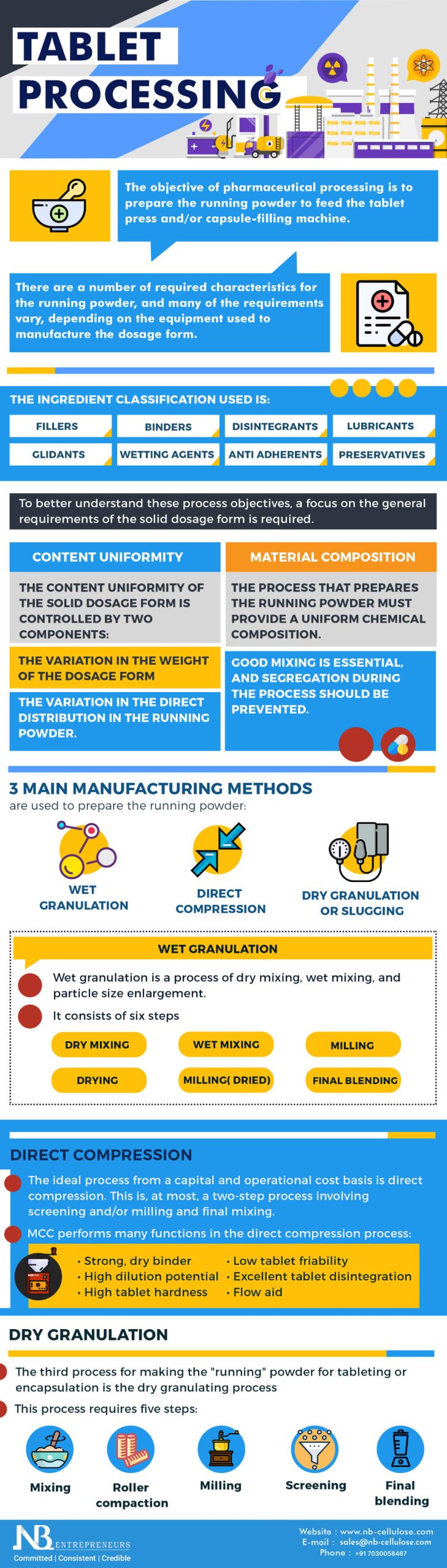
1. Direct Compression
Direct compression is one of the simplest and most efficient tablet manufacturing methods. In this process, APIs are blended directly with suitable excipients and compressed into tablets without any granulation step.
Advantages of Direct Compression in Tablet Processing
- Faster production
- Lower manufacturing cost
- Reduced processing steps
- Better stability for moisture- and heat-sensitive drugs
- Easy scale-up for commercial production
This method requires excipients with excellent flowability and compressibility, such as Microcrystalline Cellulose (MCC) and co-processed excipients.
2. Wet Granulation
Wet granulation is widely used when powders have poor flow or compressibility. A binding solution is added to create granules, which are then dried, milled, blended, and compressed into tablets.
Benefits
- Improved powder flow
- Better compressibility
- Enhanced content uniformity
- Reduced dust generation
- Stronger tablets
Although highly reliable, wet granulation involves additional equipment, drying time, and production costs.
3. Dry Granulation
Dry granulation is suitable for moisture-sensitive and heat-sensitive formulations. Instead of using liquid binders, powders are compacted into slugs or ribbons and then milled into granules before compression.
Advantages
- No water or solvents required
- Suitable for sensitive APIs
- Lower drying requirements
- Improved powder handling
- Better content uniformity
Dry granulation provides a practical alternative when wet granulation is not feasible.
Learn more about the Tableting process on Wikipedia.
Your Trusted Partner for Premium Pharmaceutical Excipients
Delivering high-quality excipients with consistent performance for pharmaceutical manufacturers worldwide.
👉 Request a Quote
Key Stages of Tablet Processing
A standard tablet manufacturing process includes several important stages:
Material Dispensing
Raw materials are accurately weighed according to the approved formulation.
Blending
Active ingredients are mixed with pharmaceutical excipients to ensure uniform distribution.
Granulation (if required)
The powder blend is processed using wet or dry granulation techniques to improve flow and compressibility.
Drying
Granules are dried to achieve the desired moisture level.
Milling and Sieving
Granules are milled to obtain a consistent particle size.
Final Blending
Lubricants, glidants, and disintegrants are added before compression.
Tablet Compression
The final blend is compressed into tablets using a tablet press under controlled pressure.
Coating (Optional)
Some tablets receive film or sugar coatings to improve appearance, stability, taste masking, or modified drug release.
Packaging
Finished tablets are packed in blister packs or bottles to protect them from moisture, light, and contamination.
Role of Pharmaceutical Excipients in Tablet Processing
Pharmaceutical excipients are essential for successful tablet manufacturing. They improve processing efficiency and ensure the finished tablets meet quality standards.
Common excipients include:
- Microcrystalline Cellulose (MCC) – Binder and diluent
- Silicified Microcrystalline Cellulose (SMCC) – Enhanced flowability and compressibility
- Sodium Starch Glycolate – Superdisintegrant
- Pregelatinized Starch – Binder and disintegrant
- Mannitol – Diluent with excellent mouthfeel
- Co-Processed Excipients – Multifunctional ingredients designed for superior tablet performance
Selecting the right excipient combination significantly improves tablet hardness, disintegration time, and manufacturing consistency.
Common Challenges in Tablet Processing
Despite technological advancements, manufacturers may encounter several challenges, including:
- Poor powder flow
- Tablet capping and lamination
- Weight variation
- Inconsistent hardness
- Sticking and picking
- Slow disintegration
- Low compressibility
These issues can often be resolved through optimized formulations, proper equipment settings, and the use of high-performance pharmaceutical excipients.
Future of Tablet Processing
Modern pharmaceutical manufacturing is increasingly adopting advanced technologies such as continuous manufacturing, Quality by Design (QbD), Process Analytical Technology (PAT), and multifunctional co-processed excipients. These innovations improve production efficiency, reduce variability, and ensure consistent product quality while meeting stringent global regulatory requirements.
Conclusion
Tablet processing is the foundation of pharmaceutical tablet manufacturing, ensuring every tablet delivers the intended dose, quality, and performance. Whether manufacturers choose direct compression, wet granulation, or dry granulation, selecting the appropriate processing method and high-quality pharmaceutical excipients is critical to producing safe, effective, and reliable medicines.
As pharmaceutical formulations become more complex, advanced excipients and modern processing technologies continue to play a key role in enhancing manufacturing efficiency and product quality.
Frequently Asked Questions
1. What is tablet processing?
Tablet processing is the pharmaceutical manufacturing process of converting powdered ingredients into tablets through blending, granulation (if required), compression, and packaging.
2. What are the main methods of tablet processing?
The three primary methods are direct compression, wet granulation, and dry granulation.
3. Why are pharmaceutical excipients important in tablet processing?
Excipients improve powder flow, compressibility, tablet strength, stability, disintegration, and overall manufacturing efficiency.
4. Which tablet processing method is best?
The ideal method depends on the formulation. Direct compression is efficient for suitable powders, while wet and dry granulation are preferred for formulations requiring improved flow and compressibility.
Looking for Premium Pharmaceutical Excipients?
NB Cellulose offers a comprehensive range of high-quality pharmaceutical excipients, including Microcrystalline Cellulose (MCC), Silicified MCC, Sodium Starch Glycolate, Pregelatinized Starch, Mannitol, and co-processed excipients to support efficient tablet processing and superior formulation performance.
Contact our team today to discuss your formulation requirements or request a product sample.


0 comments
No approved comments found.