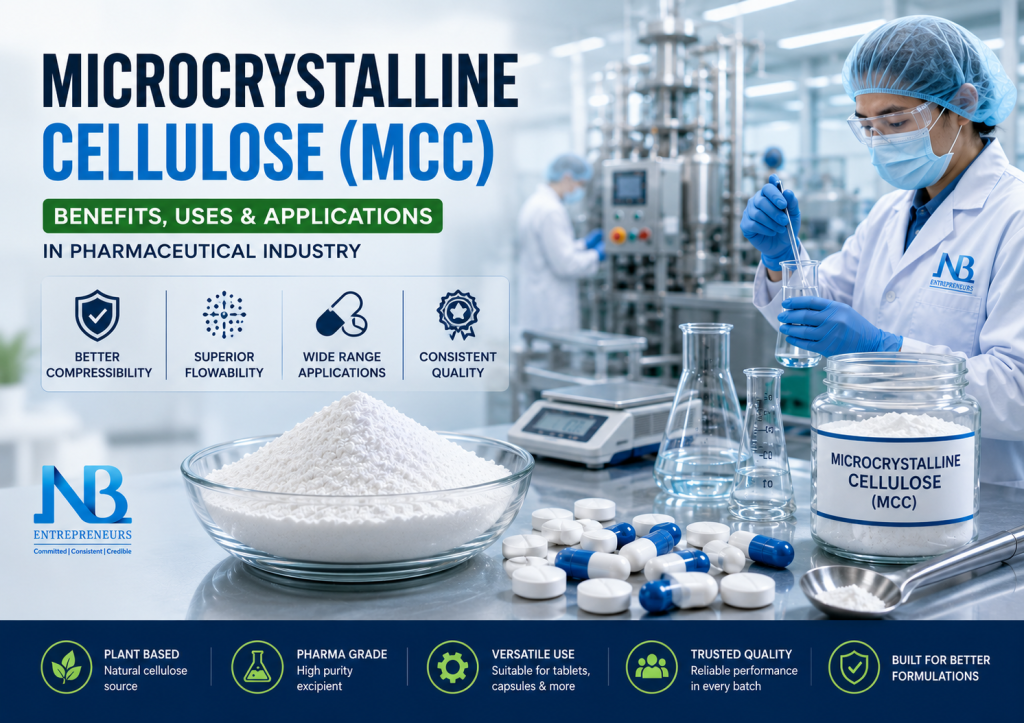
What is Microcrystalline Cellulose? Know the Benefits, Uses, & Applications in the Pharmaceutical Industry (2026 Guide)
What is Microcrystalline Cellulose (MCC) is a purified, partially depolymerised cellulose. It is obtained from natural plant fibres. It is one of the most commonly used pharmaceutical excipients used as a binder, filler, diluent and disintegrant. It aids in compression with excellent flowability and tablet stability. Its multifunctional properties make it a crucial component in present-day tablet production.
MCC can enhance manufacturing efficiency, tablet compression strength, and dosage uniformity when used as an excipient in pharmaceutical tablets, nutraceutical supplements, veterinary drugs, and/or herbal formulations. It is now widely recognized and has been used in numerous formulations in various markets, including USP, EP(European Pharmacopoeia ) and BP(British Pharmacopoeia) and is produced using good manufacturing practices (GMP) quality systems, making it the preferred choice of formulation scientists and pharmaceutical manufacturers worldwide.
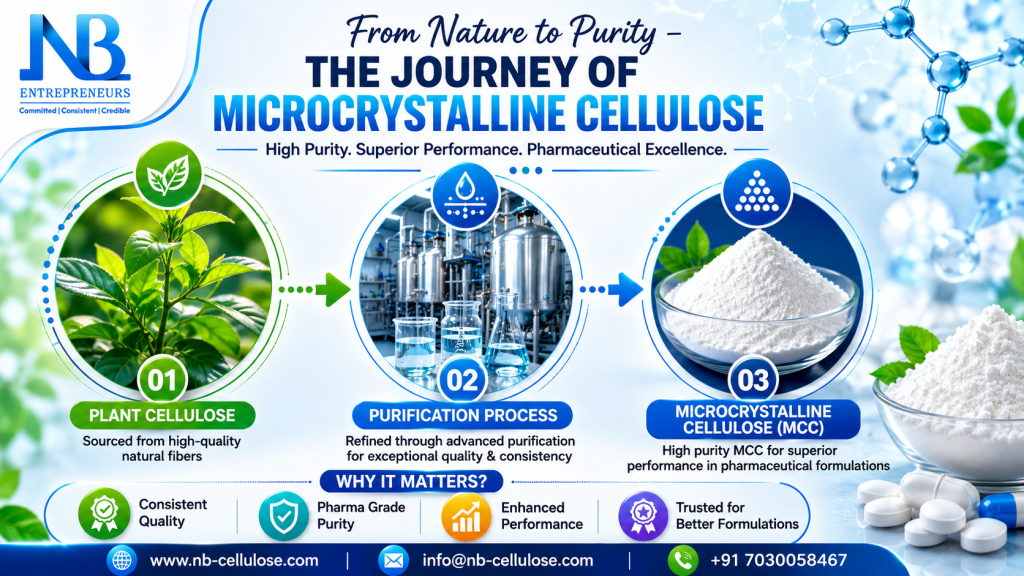
Making perfect sense of its name, SANCEL™ – Microcrystalline Cellulose, produced by NB Entrepreneurs, is a high-quality product, specially formulated for pharmaceutical use, offering reliable batch-to-batch performance, outstanding compressibility, and consistent quality across a broad spectrum of pharmaceutical formulations.
Here you would know about the manufacturing process, uses and benefits of Microcrystalline Cellulose and how to select a Microcrystalline Cellulose manufacturer or Microcrystalline Cellulose supplier.
What is Microcrystalline Cellulose & What Makes Microcrystalline Cellulose So Important?
Compared with other pharmaceutical excipients which are used for a single purpose, MCC is regarded as a multifunctional excipient.
It can help to enhance:
- Tablet hardness
- Powder flow
- Blend uniformity
- Compressibility
- Disintegration
- Manufacturing efficiency
This blend guarantees tablets’ quality, stability and performance during the entire shelf life.
Why Pharmaceutical Companies Prefer Microcrystalline Cellulose
The manufacturer chooses MCC due to the following advanatages:
Key Advantages
- Excellent compressibility for direct compression
- Superior powder flow properties
- Uniform particle size distribution
- Improved tablet hardness
- Reduced tablet friability
- Faster production cycles
- High compatibility with Active Pharmaceutical Ingredients (APIs)
- Low moisture content
- Excellent chemical stability
- Regulatory acceptance worldwide
These benefits make MCC one of the best choices for the pharmaceutical manufacturers to consider.
Looking for a Trusted Microcrystalline Cellulose Manufacturer?
Choosing the right pharmaceutical excipient is essential for producing high-quality tablets and capsules. Explore SANCEL™ Microcrystalline Cellulose from NB Entrepreneurs, available in multiple pharmaceutical grades with excellent compressibility, superior flowability, and consistent batch-to-batch quality.
👉 Microcrystalline Cellulose Manufacturer
Microcrystalline Cellulose Uses in the Pharmaceutical Industry
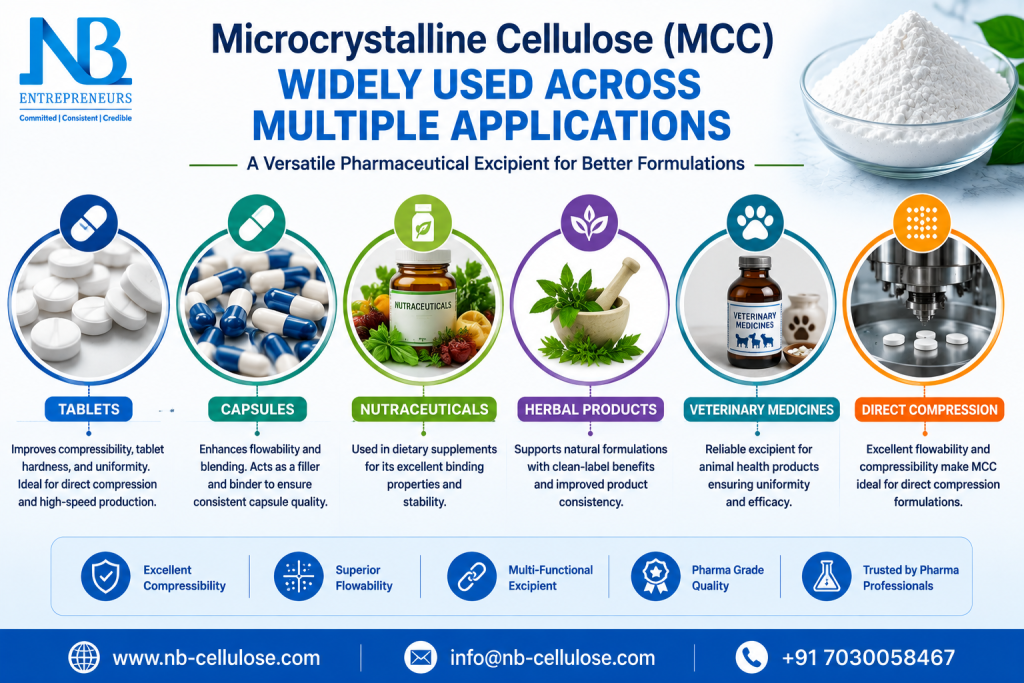
Microcrystalline cellulose Uses include pharmaceutical, nutraceutical, healthcare and other applications. Microcrystalline Cellulose (MCC) is one of the most versatile pharmaceutical excipients used in tablets, capsules, dietary supplements, and other solid dosage formulations. The unique combination of its multifunctional properties (excellent compressibility, superior flowability, reliable binding properties) enhances the efficiency of the manufacturing process, while maintaining product quality and performance.
1. Tablet Binder
MCC is an effective binder and can be used to ensure that the powder particles can be compressed into hard, durable tablets, with increased hardness and low friability.
2. Diluent (Filler)
MCC is used to improve content uniformity and weight uniformity of the tablets when the active pharmaceutical ingredient (API) is in a small amount.
3. Direct Compression Excipient
MCC’s compressibility and flowability are ideal for direct compression applications, which simplify manufacturing processes, process times and manufacturing costs.
4. Capsule Formulations
For both pharmaceutical and nutraceutical capsule filling, MCC enhances powder flowability, which leads to accurate dosing and consistent fill weight.
5. Nutraceutical & Herbal Products
In vitamins, dietary supplements, herbal tablets and wellness products, MCC is utilized by manufacturers to boost the strength, stability and manufacturing uniformity of tablets.
6. Veterinary Medicines
MCC is also employed in veterinary medicines, where it adds strength to tablets and aids manufacturing of animal health products.
SANCEL™ by NB Entrepreneurs is a high-quality Microcrystalline Cellulose of pharmaceutical grade with superior compressibility, flowability and tablet performance in all types of tablet, capsule, nutraceutical and veterinary dosage forms.
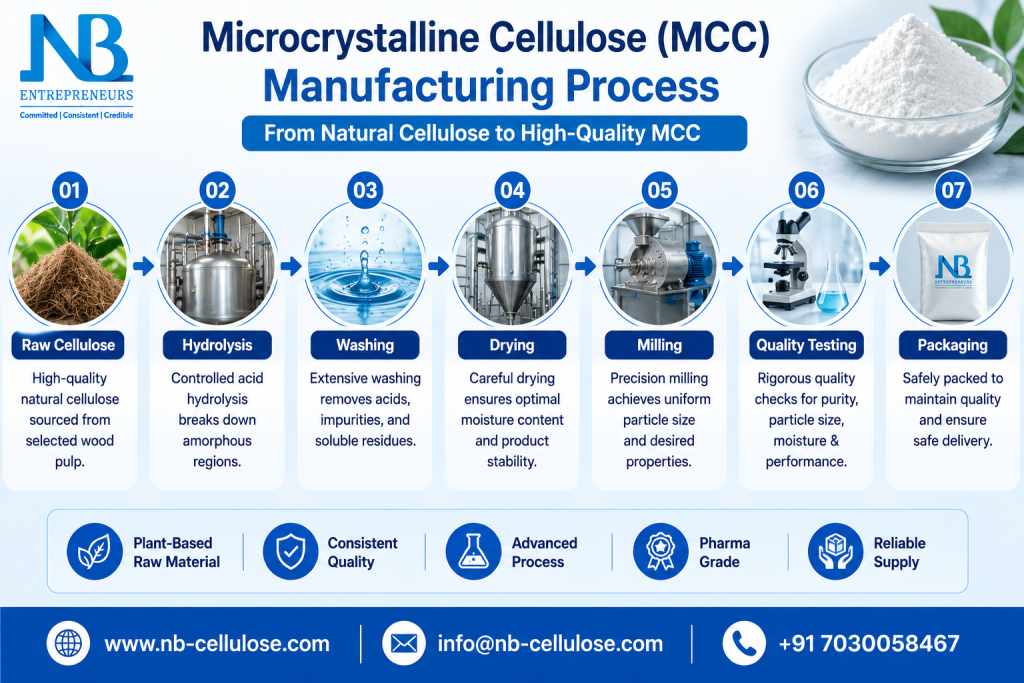
How is Microcrystalline Cellulose Manufactured?
Microcrystalline Cellulose is manufactured from purified alpha-cellulose derived from cellulose that is sourced from renewable plants like wood pulp.
While manufacturing it goes through following stages:
| Manufacturing Stage | Purpose |
| Purified Cellulose Selection | High-quality raw material |
| Controlled Hydrolysis | Removes amorphous cellulose |
| Washing & Neutralization | Eliminates residual chemicals |
| Drying | Achieves controlled moisture |
| Milling | Produces desired particle size |
| Sieving | Ensures uniform distribution |
| Quality Testing | Meets USP/EP/BP specifications |
| Packaging | Prevents contamination |
Every production batch is put through stringent quality assurance prior to reaching the pharmaceutical manufacturers.
Physical & Chemical Properties of MCC
Chemical and physical properties of MCC have been described below:
| Property | Description |
| Appearance | White, odorless crystalline powder |
| Solubility | Practically insoluble in water |
| Compressibility | Excellent |
| Flowability | Excellent |
| Moisture Content | Low |
| Stability | High |
| Compatibility | Excellent with most APIs |
| Shelf Life | Long under recommended storage conditions |
These properties play directly in the manufacturing efficiency and product consistency.
Major Functions of Microcrystalline Cellulose
Important roles of MCC in pharmaceuticals are described below in the table
| Function | Importance |
| Binder | Improves tablet strength |
| Diluent | Adds bulk where API quantity is low |
| Filler | Ensures uniform tablet weight |
| Compression Aid | Supports direct compression |
| Disintegrant | Promotes tablet breakup after administration |
| Flow Aid | Improves powder movement during processing |
These ingredients allow manufacturers to streamline their formulation and production.
Microcrystalline Cellulose Benefits for Pharmaceutical Manufacturing
1. Excellent Compressibility
MCC can be used to make tablets which are highly mechanically strong even under relatively low compression. This helps to minimise breakage of the tablet and to enhance productivity.
2. Superior Flowability
Uniform powder flow will facilitate the die filling, decrease the weight variation and allow high-speed tablet production.
3. Better Tablet Hardness
Microcrystalline Cellulose forms tablets that are strong enough to be coated, packaged, transported and handled.
4. Low Friability
Tablets made with MCC have fewer chances of chipping or breaking during manufacture and shipping.
5. Faster Manufacturing
Many MCC grades can be compressed directly, which helps manufacturers save time and money because they don’t need to use unnecessary granulation steps in their process.
6. Broad API Compatibility
A wide range of pharmaceutical ingredients will work with MCC, which is suitable for many therapy categories.
Common Pharmaceutical Applications
Microcrystalline Cellulose may be used in a variety of dosage forms.
| Dosage Form | Purpose |
| Tablets | Binder & filler |
| Capsules | Diluent |
| Chewable Tablets | Texture improvement |
| Orally Disintegrating Tablets | Compression support |
| Nutraceutical Tablets | Bulk agent |
| Herbal Products | Excipient |
| Veterinary Medicines | Tablet manufacturing |
It is versatile and can be used in both standard formulations and specialized formulations.
| Need Better Flowability and Tablet Performance? If your formulation requires enhanced flowability, improved compressibility, and superior tablet performance, discover STARCEL™ Silicified Microcrystalline Cellulose (SMCC). It is specially engineered for modern pharmaceutical formulations and high-speed tablet manufacturing. 👉 Silicified Microcrystalline Cellulose (SMCC) |
Introducing SANCEL™
Developed by NB Entrepreneurs, SANCEL™ is the ultimate brand of Microcrystalline Cellulose (MCC) for pharmaceutical, nutraceutical and healthcare applications.
SANCEL™ is produced in line with severe quality requirements and is guaranteed to offer the following:
- Uniformity in particle sizes
- Excellent compressibility
- Superior flow properties
- Reliable batch-to-batch consistency
- Met international quality standards.
SANCEL™ is not a new material, it is NB Entrepreneurs line of pharmaceutical grade Microcrystalline Cellulose in a variety of grades to meet various formulation and manufacturing demands.
In the following section, we will look at the different MCC grades, how it compares to other excipients that are commonly used (such as lactose and starch), regulatory standards, and answer some of the common questions, as well as discussing how to select the correct grade of MCC for your formulation.
Different Grades of Microcrystalline Cellulose (MCC)
The choice of grade of Microcrystalline Cellulose is critical as much as the Active Pharmaceutical Ingredient (API). Every MCC grade has been designed to have a particular particle size, bulk density and flow properties to suit the requirements of the formulation and manufacturing process.
Whether you are creating conventional tablets, high-speed compression tablets, or nutraceutical supplements, selecting the appropriate tablet grade can lead to greater tablet hardness, fewer production problems and higher tablet production efficiencies.
Popular MCC Grades
| Grade | Typical Characteristics | Common Applications |
| PH101 | Fine particle size, excellent compressibility | Wet granulation, conventional tablets |
| PH102 | Larger particle size with better flow | Direct compression tablets |
| PH200 | Improved flowability | High-speed tablet manufacturing |
| PH301 | Higher bulk density | Moisture-sensitive formulations |
| PH302 | High density with superior flow | Large tablets and specialty formulations |
The machine from each grade is chosen according to the formulation goals, equipment capacity, size of the tablet and the production speed desired.
How to Choose the Right MCC Grade
Normally, formulation scientists test several important parameters before deciding on a grade.
Consider the Following
The number of manufacturing processes used to make pills.Variety of the process used to produce pills.
- Active ingredient concentration
- Desired tablet hardness
- Powder flow characteristics
- Compression speed
- Moisture sensitivity
- Final tablet size
- Regulatory requirements
This selection of the appropriate MCC grade during formulation development can help to minimise manufacturing issues later on in commercial production.
Microcrystalline Cellulose vs Other Pharmaceutical Excipients
Despite the availability of several excipients that perform multiple similar functions, Microcrystalline Cellulose is remarkable in that it has more than one function in one ingredient.
| Property | Microcrystalline Cellulose | Lactose | Starch | Dicalcium Phosphate (DCP) |
| Compressibility | Excellent | Good | Moderate | Moderate |
| Flowability | Excellent | Good | Fair | Excellent |
| Binder Function | Excellent | Limited | Poor | Poor |
| Disintegrant Property | Good | No | Excellent | No |
| Direct Compression | Excellent | Moderate | Limited | Good |
| Moisture Sensitivity | Low | Moderate | High | Low |
| API Compatibility | Excellent | Good | Good | Moderate |
Why MCC Performs Better
MCC differs from lactose or starch in that it is
- Binder
- Diluent
- Compression aid
- Flow enhancer
- Disintegration supporter
This multifunctional nature makes formulations easier and in many instances allows reduction of the excipients in a tablet formulation.
Applications of Microcrystalline Cellulose Across Industries
While MCC is primarily known as a pharmaceutical excipient, it can be used in a variety of industries because of its exceptional functional properties.
| Industry | Application |
| Pharmaceutical | Tablets, capsules, direct compression formulations |
| Nutraceutical | Vitamins, minerals, dietary supplements |
| Herbal Products | Ayurvedic and botanical tablets |
| Veterinary | Animal healthcare formulations |
| Food | Stabilizer, anti-caking agent, texture improver |
| Personal Care & Cosmetics | Powder products, pressed cosmetics, skincare formulations |
The versatility of this product has resulted in it being one of the most widely used cellulose based ingredients all over the world.
Quality Standards and Regulatory Compliance
Quality plays a crucial role in the manufacturing process of the tablets. SANCEL meets internationally accepted pharmacopoeial standards.
Common Standards
- USP (United States Pharmacopeia)
- EP (European Pharmacopoeia)
- BP (British Pharmacopoeia)
- GMP (Good Manufacturing Practices)
- ISO Quality Management Systems
It is important to hold detailed quality documentation that includes Certificates of Analysis (COA), Safety Data Sheets (SDS) and batch traceability records.
Why Choose SANCEL™ Microcrystalline Cellulose by NB Entrepreneurs?
The NB Entrepreneurs product SANCEL™ has been designed to accommodate the changing needs of a range of manufacturers in the pharmaceutical, nutraceutical and healthcare sectors.
SANCEL™ has several key features:
- Pharmaceutical-grade Microcrystalline Cellulose
- Excellent compressibility
- Reliable flow characteristics
- High specific surface area and good strength
- Multiple grades can be used for multiple formulations.
- Produced at high quality standards.
- Batch-to-batch consistency
- Technical assistance in formulation development.
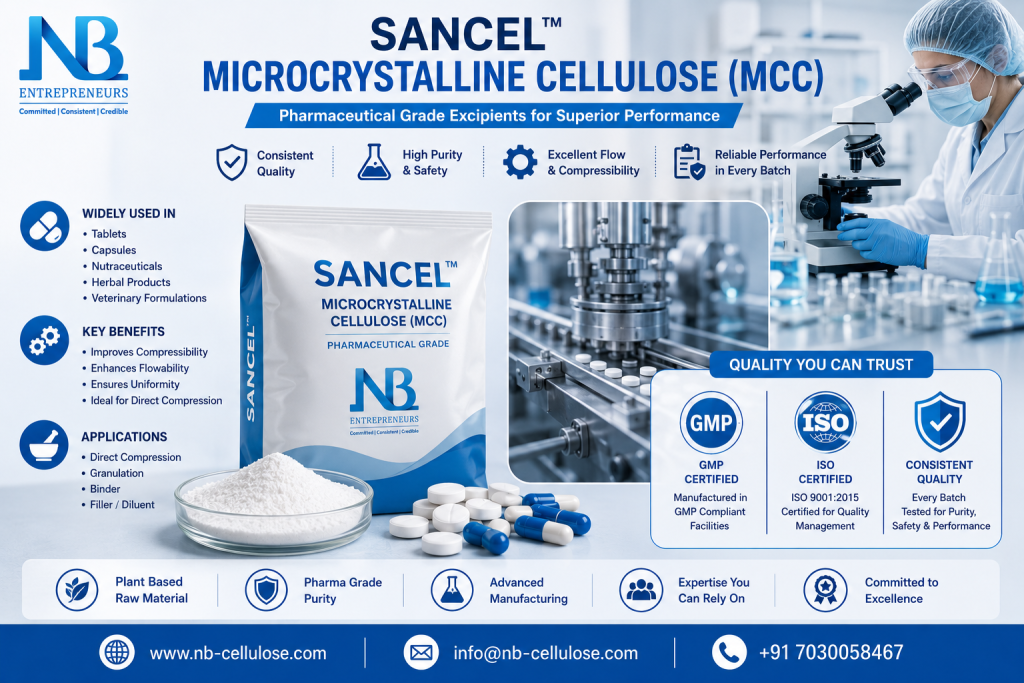
Suitable Applications
- Direct compression tablets
- Wet granulation
- Capsule filling
- Nutraceutical products
- Herbal formulations
- Veterinary medicines
With SANCEL™ grades, the manufacturer can ensure a constant tablet quality and adjust the grade to optimise production efficiency.
Best Practices for Handling and Storage
Microcrystalline Cellulose is recommended to be stored under the recommended environmental conditions to preserve the product quality.
Storage Recommendations
- Store in a cool, dry place.
- Keep containers tightly closed after use.
- Protect from excessive humidity.
- Avoid direct sunlight.
- Use clean and dry handling equipment.
- Follow First-In, First-Out (FIFO) inventory practices.
Appropriate storage conditions allow for flowability, moisture and product performance to be maintained.
Frequently Asked Questions on What is Microcrystalline Cellulose
1. What are the uses of Microcrystalline Cellulose?
It is mainly used as Binder, Diluent, Filler and Compression Aid in pharmaceutical tablets and capsules.
2. Is Microcrystalline Cellulose safe?
Yes. Pharmaceutical grade MCC has been safely used for a considerable period of time and is approved in key pharmacopoeias when used in accordance with relevant specifications.
3. Can MCC be dissolved in water?
No. MCC is almost insoluble in water but disperses well in water.
4. Why is direct compression preferred in MCC?
It has a good compressibility and it is also easy to flow so that tablets can be efficiently produced without complicated granulation processes.
5. Which industries use MCC?
Industrial applications in pharmaceutical, nutraceutical, food, cosmetic, veterinary and herbal products.
6. What MCC grade is the best one?
There is no “best” grade. The optimum grade is subjective and is based on the type of formulation, the manufacturing process and the properties of the tablet that are desired.
7. Is SANCEL™ different from Microcrystalline Cellulose?
SANCEL™ is NB Entrepreneurs’ top quality pharmaceutical grade Microcrystalline Cellulose made in various grades to meet the formulation needs.
8. Is it possible to enhance the hardness of the tablets made by MCC?
Yes. Some of the important factors associated with manufacturers deciding to go for MCC is to manufacture tablets which are strong and durable with good mechanical strength.
9. Does MCC work with most Active Pharmaceutical Ingredients?
Generally, yes. MCC carries a good amount of compatibility with diverse Active Pharmaceutical Ingredients.
10. Why is it important for manufacturers to choose a trusted supplier of MCCs?
A trusted supplier will always provide you with a uniform product, technical support, regulatory documentation and a consistent batch-to-batch performance.
Conclusion
Microcrystalline Cellulose has become one of the most important multifunctional excipients in modern pharmaceutical manufacturing. It is an unreplaceable ingredient in tablet/capsule formulations, nutraceuticals and many more of healthcare products for its outstanding compressibility, excellent flowability, broad API compatibility and multiple formulation function.
In addition to pharmaceutical applications, MCC has also played a key role in revolutionary innovation in the fields of food, cosmetic and veterinary applications, highlighting the versatility and long-term benefits of the company.
It’s not just about choosing the right grade MCC, it’s equally crucial for manufacturers to select a reliable supplier that can ensure consistent quality and reliable performance. SANCEL™ by NB Entrepreneurs provides an extensive line of Microcrystalline Cellulose, a pharmaceutical grade ingredient, which enables the effective manufacture, regulatory compliance and production of high-quality pharmaceutical products.
When evaluating a new formulation or optimising an existing process, it’s essential to choose the right type of Microcrystalline Cellulose for its grade to enhance product quality and production efficiency.
| 🚀 Looking for a Reliable Pharmaceutical Excipient Partner? Whether you’re developing a new formulation, scaling production, or searching for a trusted supplier of Microcrystalline Cellulose (MCC) or Silicified Microcrystalline Cellulose (SMCC), NB Entrepreneurs is here to support your pharmaceutical manufacturing needs with high-quality excipients and expert technical assistance. Get Started Today ✅ Request a Quote for your product requirements and receive a customized solution from our technical team. 🤝 Become a Partner and collaborate with a trusted pharmaceutical excipient manufacturer committed to quality, consistency, and long-term success. |


0 comments
No approved comments found.