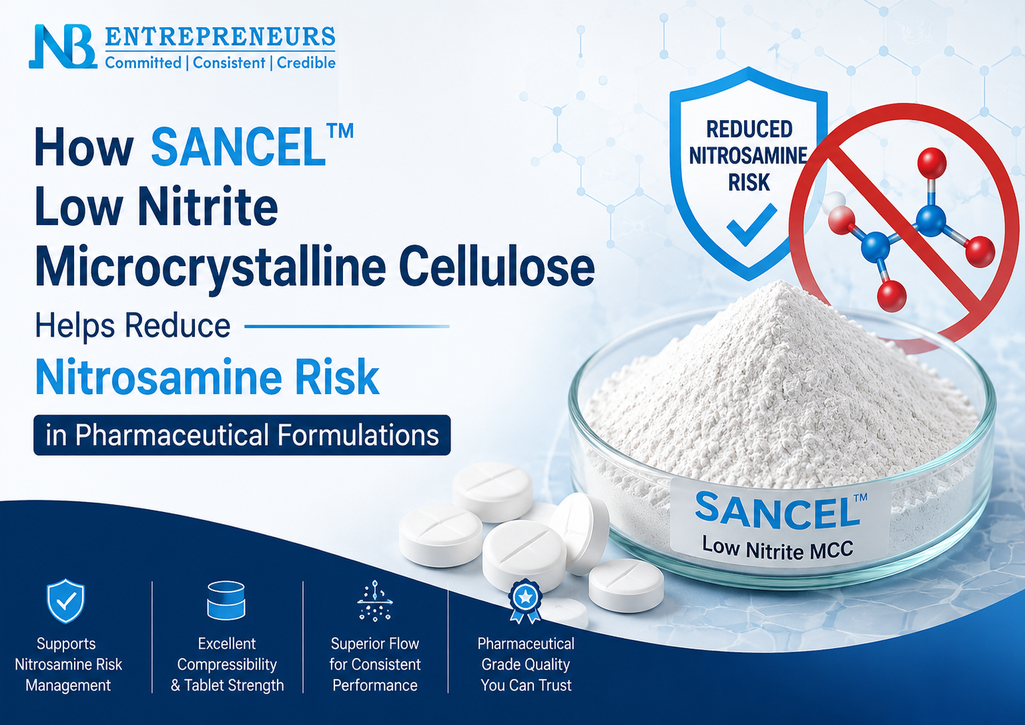
How SANCEL™ Low Nitrite Microcrystalline Cellulose Helps Reduce Nitrosamine Risk in Pharmaceutical Formulations
The pharmaceutical industry is constantly evolving to meet higher standards of quality, safety, and regulatory compliance. One topic that has gained significant attention in recent years is nitrosamine risk. Regulatory authorities worldwide now expect pharmaceutical manufacturers to identify and minimize every possible source of nitrosamine formation—not only from active pharmaceutical ingredients (APIs) but also from excipients used in formulations.
Among these excipients, microcrystalline cellulose (MCC) plays a critical role. As one of the most widely used pharmaceutical excipients, MCC is present in countless tablet and capsule formulations because of its excellent binding, compressibility, and flow properties. However, since MCC is often used in relatively high concentrations, its nitrite content has become an important consideration during formulation development.
This is where SANCEL™ Low Nitrite Microcrystalline Cellulose (LN MCC) offers added value. Manufactured with controlled nitrite levels while maintaining the trusted performance of conventional MCC, it helps pharmaceutical companies strengthen their nitrosamine risk assessment strategy without compromising product quality.
Why Are Nitrosamines a Concern in Pharmaceuticals?
Nitrosamines are chemical compounds that can form when nitrites react with certain amine-containing substances under specific manufacturing, storage, or processing conditions. Although these compounds are generally present only in trace amounts, they have become an important focus for pharmaceutical manufacturers because some nitrosamines are classified as probable human carcinogens.
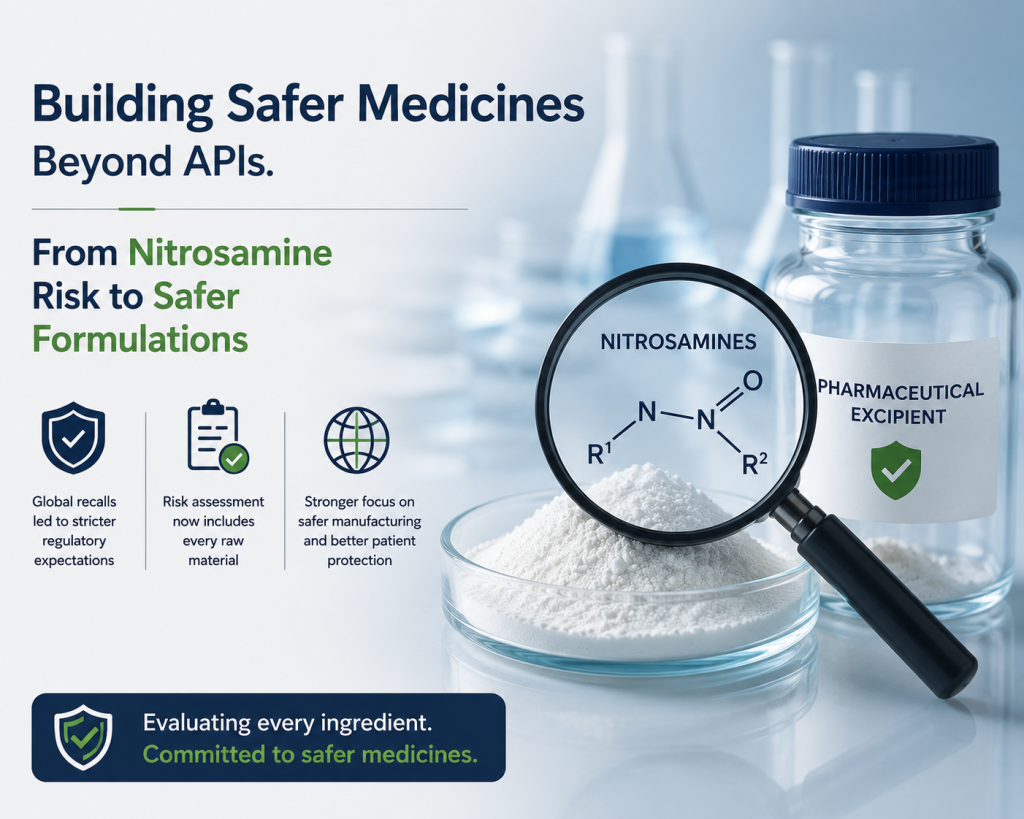
Following several global drug recalls over the past few years, regulatory agencies such as the US FDA, EMA, and other international authorities have introduced stricter expectations for identifying and reducing potential nitrosamine risks throughout the manufacturing process.
Rather than looking only at APIs, today’s pharmaceutical companies are evaluating every raw material, including excipients, to build safer formulations.
Why Does Nitrite Content in Microcrystalline Cellulose Matter?
Microcrystalline cellulose is one of the most commonly used excipients in tablet manufacturing. Depending on the formulation, it may account for 20–70% of the total tablet weight.
Because MCC represents such a large portion of many formulations, even naturally occurring trace levels of nitrite can become relevant during a comprehensive nitrosamine risk assessment.
This does not mean that every formulation containing MCC will develop nitrosamines. Instead, it highlights why pharmaceutical manufacturers increasingly evaluate the nitrite profile of their excipients as part of a broader risk management strategy.
Choosing a low-nitrite microcrystalline cellulose can therefore help reduce one potential contributor during formulation development. sider.
What Is SANCEL™ Low Nitrite Microcrystalline Cellulose?
Sancel™ Low Nitrite Microcrystalline Cellulose is a pharmaceutical-grade MCC specifically manufactured with controlled low nitrite levels while maintaining the functional benefits expected from high-quality microcrystalline cellulose.
Unlike alternative excipients, SANCEL™ LN MCC does not require manufacturers to redesign their formulation. It continues to provide the same dependable performance that formulators expect, including:
Excellent compressibility
Reliable binding properties
Good powder flow
Uniform tablet weight
Consistent tablet hardness
Compatibility with various manufacturing processes
This makes it an ideal choice for pharmaceutical companies looking to strengthen their formulation strategy while supporting modern quality expectations.
How Sancel™ Low Nitrite MCC Supports Nitrosamine Risk Reduction?
Managing nitrosamine risk requires evaluating every possible source of nitrite within a formulation. Since excipients can contribute trace nitrite levels, selecting materials with controlled specifications becomes an important part of the overall strategy.
SANCEL™ Low Nitrite MCC helps by offering:
Conventional MCC
SANCEL™ Low Nitrite MCC
Standard nitrite profile
Controlled low nitrite levels
General pharmaceutical applications
Suitable for formulations requiring enhanced nitrite awareness
It is important to note that low nitrite MCC does not eliminate nitrosamines. Instead, it helps pharmaceutical manufacturers reduce one potential source of nitrite, supporting a more robust formulation development process.
Enhance Your Pharmaceutical Formulations with SANCEL™ Low Nitrite MCC
Looking for a pharmaceutical-grade Low Nitrite Microcrystalline Cellulose that supports your nitrosamine risk assessment strategy? SANCEL™ LN MCC combines controlled low nitrite levels with reliable tablet performance, making it an ideal choice for modern pharmaceutical formulations.
Request a quote today for technical information, discuss your formulation needs, or receive a product sample
Key Benefits of SANCEL™ Low Nitrite Microcrystalline Cellulose
Choosing the right excipient involves more than regulatory considerations. Manufacturers also need consistent processing performance and reliable batch-to-batch quality.
SANCEL™ LN MCC offers several advantages:
✔ Controlled low nitrite levels
✔ Excellent compressibility for direct compression
✔ Superior binding performance
✔ Consistent powder flow characteristics
✔ Uniform tablet hardness
✔ Reliable batch consistency
✔ Suitable for wet granulation and dry granulation
✔ Supports Quality by Design (QbD) approaches
✔ Manufactured under stringent quality standards
These benefits allow formulators to balance performance, efficiency, and quality without compromising manufacturing productivity.
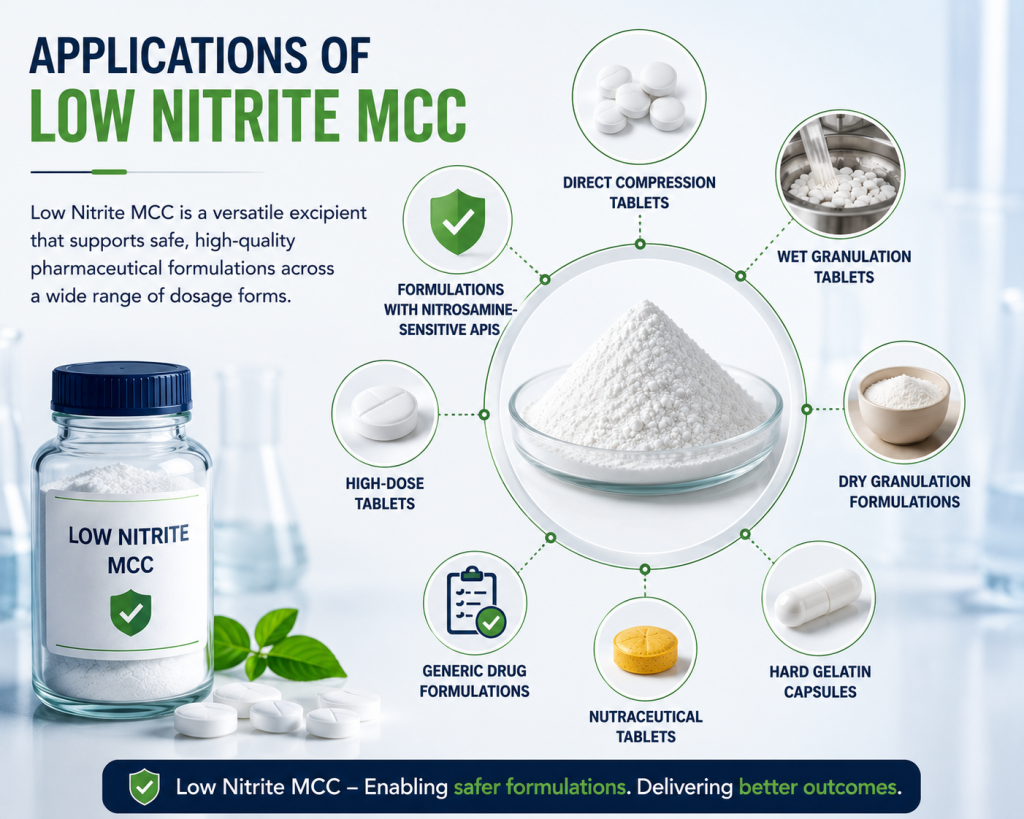
Applications of Low Nitrite MCC
Low nitrite microcrystalline cellulose is suitable for a wide range of pharmaceutical formulations, including:
As pharmaceutical regulations continue to evolve, many manufacturers are proactively evaluating excipients that contribute to improved formulation quality and regulatory preparedness.
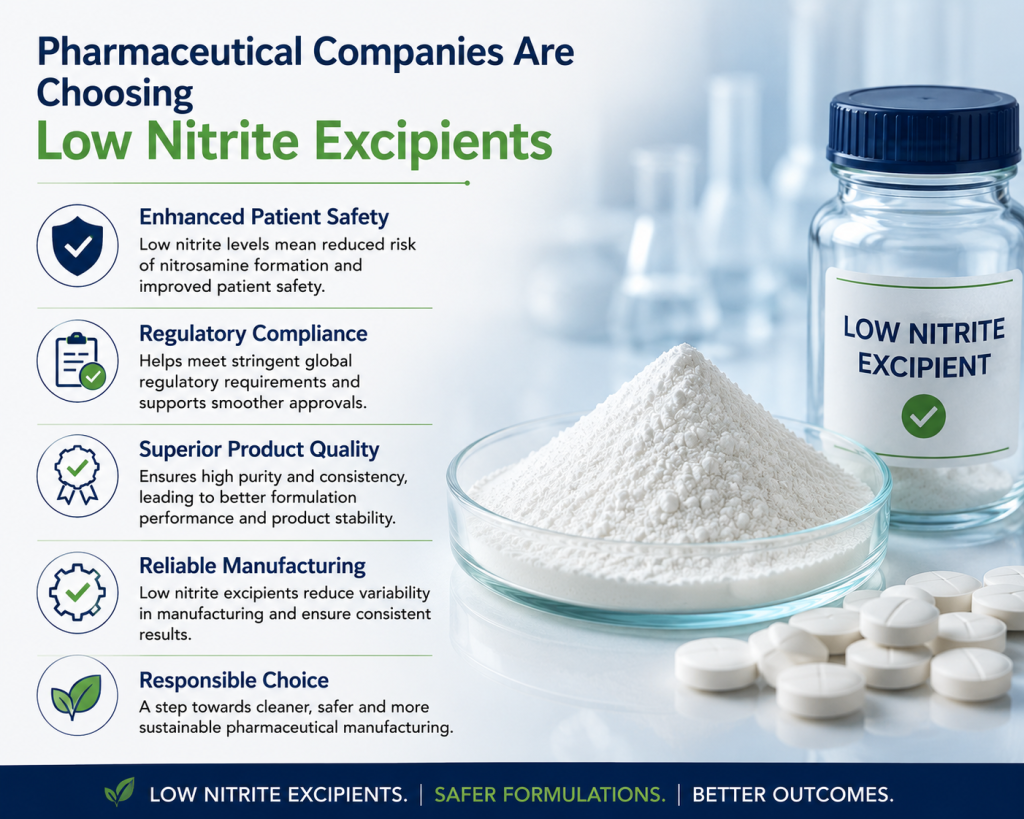
Why Are Pharmaceutical Companies Choosing Low Nitrite Excipients?
The pharmaceutical industry has shifted from simply meeting regulatory requirements to adopting proactive risk management.
Today, formulation scientists increasingly consider the following:
API characteristics
Manufacturing process
Storage conditions
Packaging materials
Excipient quality
Selecting a low-nitrite microcrystalline cellulose is one practical way to strengthen this strategy.
Instead of making major formulation changes, manufacturers can reduce potential nitrite contribution from one of their highest-volume excipients while maintaining the same manufacturing performance.
This proactive approach aligns well with modern pharmaceutical development and supports long-term product quality.
? Looking for a reliable pharmaceutical excipient manufacturer?
Discover the 7 key factors every procurement and formulation team should evaluate before choosing a supplier.
Why Choose SANCEL™ Low Nitrite MCC from NB Entrepreneurs?
At NB Entrepreneurs, quality is at the core of every pharmaceutical excipient manufactured.
SANCEL™ Low Nitrite Microcrystalline Cellulose is developed to meet the growing expectations of pharmaceutical companies seeking reliable, high-performance excipients with controlled nitrite levels.
By combining advanced manufacturing processes, strict quality control, and consistent batch performance, NB Entrepreneurs helps formulation scientists develop pharmaceutical products with confidence.
Whether you’re developing a new formulation or reviewing an existing product during nitrosamine risk assessment, SANCEL™ LN MCC offers dependable functionality backed by quality-focused manufacturing.
Final Thoughts
Nitrosamine risk management has become an essential part of modern pharmaceutical development. While APIs often receive the most attention, excipients also play an important role in creating safer and more reliable formulations.
Because microcrystalline cellulose is widely used across tablet and capsule manufacturing, selecting a low nitrite MCC can help reduce one potential contributor to nitrosamine formation while maintaining the excellent performance expected from pharmaceutical-grade MCC.
SANCEL™ Low Nitrite Microcrystalline Cellulose combines controlled nitrite levels with proven functionality, making it an ideal choice for pharmaceutical manufacturers seeking quality, consistency, and greater confidence in their formulations.
As the industry continues to focus on risk-based development and regulatory compliance, choosing the right excipient today can support better pharmaceutical products tomorrow.
Ready to Strengthen Your Pharmaceutical Formulations?
As regulatory expectations for nitrosamine risk management continue to evolve, selecting the right excipient is more important than ever. SANCEL™ Low Nitrite Microcrystalline Cellulose from NB Entrepreneurs combines controlled low nitrite levels with the trusted performance of pharmaceutical-grade MCC, helping manufacturers develop high-quality, reliable formulations with confidence.
Let’s build success together Become a Partner with NB, a Leading Pharmaceutical Excipients Manufacturer
Frequently Asked Questions
Q1. What is low nitrite microcrystalline cellulose?
Low Nitrite Microcrystalline Cellulose is pharmaceutical-grade MCC manufactured with controlled nitrite levels to support formulation strategies aimed at reducing potential nitrosamine risk while maintaining excellent tablet performance.
Q2. Does low nitrite MCC eliminate nitrosamines?
No. Low Nitrite MCC does not eliminate nitrosamines. It helps reduce one potential source of nitrite in a formulation and supports a broader nitrosamine risk management strategy.
Q3. Where is low nitrite MCC used?
It is commonly used in direct compression tablets, wet granulation, dry granulation, capsules, nutraceuticals, and formulations containing nitrosamine-sensitive APIs.
Q4. Does low nitrite MCC affect tablet quality?
No. High-quality low-nitrite MCC is designed to provide the same excellent compressibility, binding strength, flowability, and tablet hardness as conventional pharmaceutical-grade microcrystalline cellulose.
Q5. Why are pharmaceutical companies adopting low nitrite excipients?
As regulatory expectations around nitrosamine risk continue to evolve, manufacturers are reviewing every component of their formulations. Low nitrite excipients help support comprehensive risk assessments while maintaining formulation performance.
NB Entrepreneurs is a top pharmaceutical excipient manufacturer in India known for delivering high-quality Co-Processed Excipients, Microcrystalline Cellulose (MCC), and advanced formulation solutions for modern tablet manufacturing. With a strong focus on quality, consistency, and innovation, the company supports pharmaceutical industries with reliable excipient solutions and global manufacturing standards.


0 comments
No approved comments found.