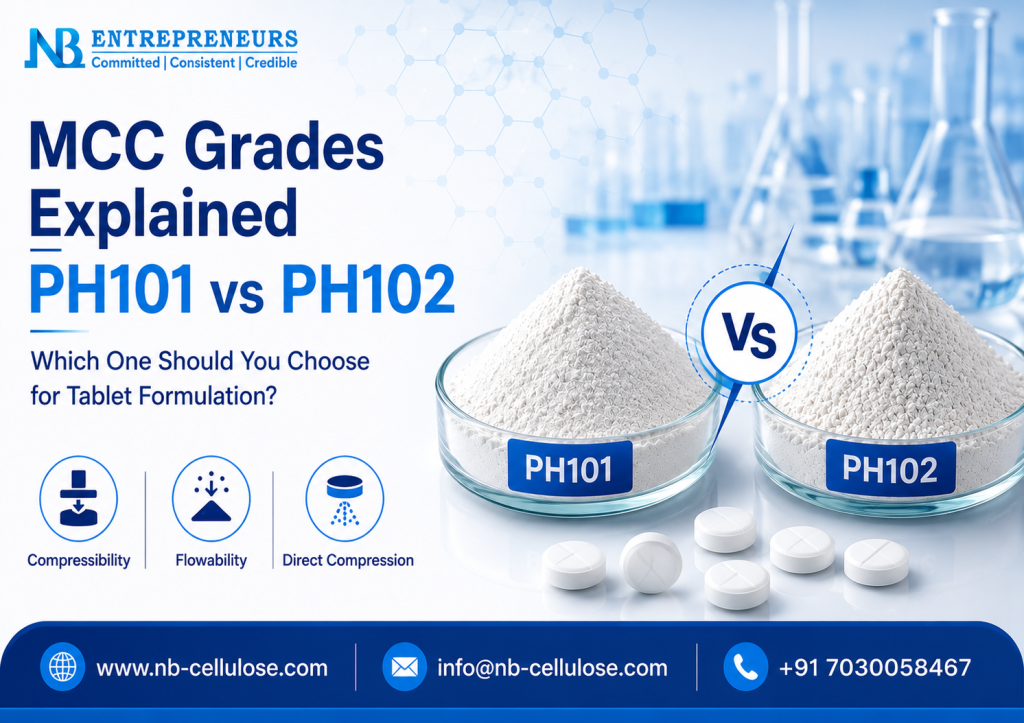
PH101 vs PH102: Which Microcrystalline Cellulose (MCC) Grade Should You Choose for Tablet Formulation?
Choosing between PH101 vs PH102 is one of the most important decisions when selecting Microcrystalline Cellulose (MCC) for tablet formulation.
Quick Answer: PH101 is a good option for formulations that need high compressibility and compaction strength. PH102 is typically recommended if good powder flow and efficient direct compression are desired. The final choice will depend on your API properties, manufacturing process, and the performance you are looking for in your tablet.
This guide outlines the distinction between PH101 and PH102, discusses their technical characteristics and offers practical advice for formulation scientists and pharmaceutical manufacturers to select the most suitable grade of MCC.
What is Microcrystalline Cellulose (MCC)?
Microcrystalline Cellulose (MCC) is one of the most commonly used excipients in oral solid dosage forms. MCC is a partially depolymerised, purified cellulose that is produced by controlled depolymerisation and has several uses in tablet formulations.
It serves several purposes, such as:
- Binder
- Diluent (filler)
- Compression aid
- The dry binder is used for direct compression.
Tablet disintegration is supported. Tablet disintegration is supported.
MCC is highly compressible, compatible with a wide variety of Active Pharmaceutical Ingredients (APIs), and easy to process, making it a popular ingredient in tablets, capsules, nutraceuticals, herbal products, and dietary supplements.
But not every MCC grade is the same, however. Each grade is appropriate for certain formulation needs due to the different size and physical properties of the particles.
Why Does MCC Have Different Grades?
All pharmaceutical-grade MCC products are made from purified cellulose, but each grade is formulated to meet specific requirements for formulation and processing.
The following are some of the key factors that distinguish MCC grades:
- Particle size distribution
- Bulk density
- Powder flowability
- Compressibility
- Manufacturing performance
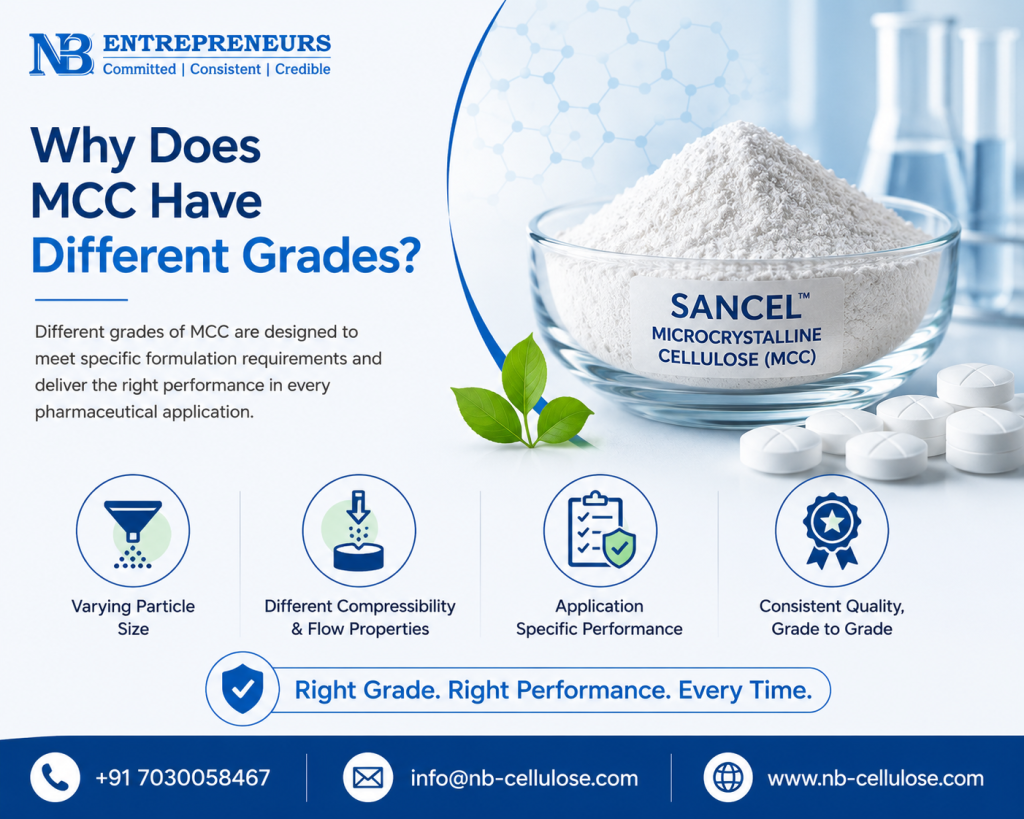
These differences affect the powder blending, die filling, compression and tablet production. Choosing the right grade can enhance process efficiency and ensure product consistency.
Different MCC grades are developed to meet specific formulation requirements while supporting consistent quality and manufacturing performance. During excipient selection, pharmaceutical manufacturers should also consider applicable regulatory expectations and guidance published by the U.S. Food and Drug Administration (FDA).
| Looking for a broader understanding of Microcrystalline Cellulose? Read our guide on Popular MCC Grades to explore their properties, applications, and formulation benefits. |
MCC PH101: Features, Benefits & Applications
MCC PH101 is a fine particle grade with excellent compressibility and good binding properties.
Key Characteristics of MCC Ph101
- Smaller particle size
- High compressibility
- Good compactability
- Suitable for direct compression and wet granulation
- Supports strong tablet hardness
Typical Applications
PH101 is typically tested for:
- Low-dose tablet formulations
- Wet granulation processes
- Tablets with low hardness
Advantages of PH101
- Excellent tablet compaction
- Strong interparticle bonding
Good uniformity of content in appropriate formulations
Good performance in many pharmaceutical applications
Due to its smaller particle size, PH101 may have reduced powder flow compared to coarser grades of MCC, and formulation evaluation is required.
MCC PH102: Features, Benefits & Applications
MCC PH102 is a coarser particle grade that is used to enhance powder flow without compromising compression properties.
Key Characteristics
- Larger particle size
- Better flowability
- Good compressibility
- Improved die-filling
- Ideal for direct compression at high speed
Typical Applications
PH102 is widely used in:
- Direct compression tablet formulations
- High-speed manufacturing
- Nutraceutical tablets
- Commercial-scale pharmaceutical production
Advantages of PH102
- Improved powder flow
- Efficient die filling
- Better manufacturing productivity
- Appropriate for high-speed rotary tablet presses
PH102 is a popular choice for large-scale tablet manufacturing due to its flowability and compressibility.
PH101 vs PH102: Side-by-Side Comparison
| Property | PH101 | PH102 |
| Particle Size | Smaller | Larger |
| Powder Flow | Good | Better |
| Compressibility | Excellent | Excellent |
| Bulk Density | Lower | Higher |
| Direct Compression | Suitable | Highly Suitable |
| Wet Granulation | Excellent | Suitable |
| Tablet Hardness | Excellent | Excellent |
| Die Filling | Good | Better |
| High-Speed Production | Suitable | Preferred |
| Typical Use | Low-dose & wet granulation | Direct compression & commercial production |
The typical use of these technologies is low-dose & wet granulation, direct compression & commercial production.
Key Insight: Both grades have a similar chemical composition. The main difference is in their physical properties, such as particle size and flow properties.
Learn how SANCEL™ Low Nitrite Microcrystalline Cellulose helps pharmaceutical manufacturers reduce nitrosamine risk and develop safer, high-quality formulations.
Read the blog: How SANCEL™ Low Nitrite Microcrystalline Cellulose Helps Reduce Nitrosamine Risk
How to Choose the Right MCC Grade?
“What grade should I use for my formulation needs?”
Choose PH101 When…
Higher compressibility is important.
Hardness is an important quality attribute of tablets.
Wet granulation is a process in the manufacture.
Strong compactability is required for the formulation.
Choose PH102 When…
Improved powder flow is needed.
Direct compression is the preferred manufacturing process.
High speed tablet production is planned.
Die filling must be consistent.
Each formulation is different and always laboratory testing and process evaluation of the excipients should be used.
Why Particle Size Matters in MCC Performance?
One of the most important factors that influences the performance of MCC is particle size.
Smaller Particles
The finer particles typically offer:
- Greater surface area
- Better interparticle bonding
- Improved compactability
- Strong tablet hardness
- Larger Particles
Coarser particles tend to offer:
- Better powder flow
- Reduced segregation risk
- Improved die filling
- Higher manufacturing efficiency
Knowing these properties helps the tablet formulator to maximise tablet quality and production efficiency.
Practical Formulation Examples
The following table shows some typical tablet formulation situations.
| Formulation Requirement | Commonly Evaluated Grade |
| Low-dose formulations | PH101 |
| Direct compression | PH102 |
| Wet granulation | PH101 |
| High-speed production | PH102 |
| Improved powder flow | PH102 |
| Strong tablet hardness | PH101 |
These examples are intended as a general guide. Formulation development studies should always be used to select the final grade.
The choice of an excipient without assessing formulation needs may impact product quality and manufacturing efficiency.
Common Mistakes When Choosing MCC Grades
Choosing Based Only on Price
Reducing cost does not always reduce manufacturing costs if the process performance is sacrificed.
Ignoring API Properties
The particle size, flowability, compressibility, and moisture sensitivity of the API all affect excipient selection.
One size fits all formulations.
The processing and performance needs of different formulations vary. A good grade in one product may not be appropriate for another.
Overlooking Manufacturing Scale
Laboratory results may vary from commercial production. Powder flow and die filling are more important in high speed manufacturing.
Frequently Asked Questions
Q1. What is the difference between PH101 and PH102?
- The main difference is the size of the particles. PH101 has smaller particles and PH102 has larger particles which generally enhance powder flow.
Q2. What is the best MCC grade for direct compression?
- The use of PH102 for direct compression is often recommended due to its enhanced flowability and efficient die filling.
Q3. Is PH101 better than PH102?
- There is no one right or wrong grade. The selection depends on the formulation goals, API properties, and manufacturing needs.
Q4. Can PH101 replace PH102?
- In some formulations, substitution may be possible, but should be considered only after compatibility studies, compression trials, and formulation evaluation.
Q5. Does the grade of MCC influence the hardness of the tablet?
- Yes. The size and compressibility of the particles affect the hardness of the tablet, but the hardness also depends on the composition of the formulation, the compression force, and the manufacturing conditions.
How to Choose the Right MCC Supplier?
The selection of the appropriate MCC grade is just one part of the formulation process. A good manufacturer can help ensure the consistency of quality and technical support during the development of the product.
When assessing an MCC supplier, take into account:
- Batch-to-batch consistency
- Conformance to pharmacopoeia requirements
- Comprehensive technical documentation
- Reliable supply chain
- Technical assistance in formulation development
- Effective quality management systems
Why Choose NB Entrepreneur for MCC Grades?
We know how crucial it is to choose the right pharmaceutical excipient for each formulation at NB Entrepreneur.
Our SANCEL™ Microcrystalline Cellulose grades are produced under strict quality control to meet the requirements of the pharmaceutical and nutraceutical industry.
We will ensure that we deliver:
- Consistent product quality
- Reliable batch-to-batch performance
Multiple MCC grades for various formulation requirements
The experienced professionals provide technical support.
Documentation to meet quality and regulatory needs
We aim to assist our customers in selecting the most suitable MCC grade and to facilitate formulation development and manufacturing.
Committed to Global Quality Standards
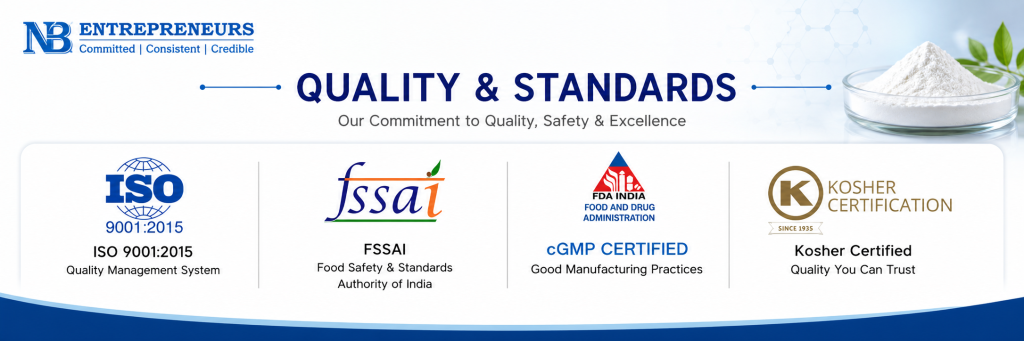
Our certifications and quality management systems reflect our commitment to delivering pharmaceutical-grade Microcrystalline Cellulose (MCC) that meets industry expectations for consistency, safety, and performance. We follow stringent manufacturing and quality control practices to support reliable tablet formulations.
Looking for a trusted pharmaceutical excipients manufacturer & supplier in India?
If your pharmaceutical or nutraceutical company is based in the United States (New York, New Jersey, Boston, Chicago, Philadelphia, Houston, Los Angeles, San Diego, San Francisco, Raleigh, or North Carolina) or the United Kingdom (London, Manchester, Birmingham, Leeds, Liverpool, Glasgow, Cambridge, or Oxford), partnering with a reliable pharmaceutical excipients manufacturer in India can help you achieve consistent quality, competitive pricing, and a dependable global supply chain.
At NB Cellulose, we manufacture premium Microcrystalline Cellulose (MCC) and other pharmaceutical excipients under the SANCEL™ brand to support formulation development and commercial production. Whether you’re looking for a long-term manufacturing partner, a private-label supplier, or technical guidance for selecting the right excipient grade, our team is ready to assist. We also welcome inquiries from pharmaceutical distributors, contract manufacturers, and formulation companies seeking a trusted sourcing partner from India.
| Ready to evaluate the quality of SANCEL™ pharmaceutical excipients for your next formulation? Contact NB Entrepreneur to request a free product sample, technical documentation, or a customized quotation. Our experts are available to discuss your formulation requirements, recommend the most suitable excipient grade, and help you build a reliable long-term supply partnership. Request a Free Sample or Quote Today |
Conclusion
The decision of which grade to take, MCC PH101 or PH102, is not a choice of the best grade. Rather, it is about knowing how the properties of each grade relate to your formulation objectives.
PH101 is typically used when compressibility and tablet strength are important, while PH102 is often chosen for formulations that need to have better powder flow and efficient direct compression. Formulation teams can make informed decisions that help ensure consistent tablet quality and manufacturing efficiency by carefully considering the characteristics of the API, its manufacturing process, and the desired product specifications.
When formulating a new product or optimizing an existing product, choosing the right grade of MCC and working with an experienced manufacturer can help to speed up product development and ensure reliable production.
| Looking for the Right MCC Grade? Talk to the technical experts at NB Entrepreneurs to find the ideal SANCEL™ Microcrystalline Cellulose solution for your tablet formulation and pharmaceutical application. ? Call: +91 7030058467 ? Email: info@nb-cellulose.com Get in touch today for expert guidance, technical support, or to request a product sample. |


0 comments
No approved comments found.