
What Is Silicified Microcrystalline Cellulose? Benefits, Uses & Applications
Silicified Microcrystalline Cellulose (SMCC) is a co-processed pharmaceutical excipient made by combining Microcrystalline Cellulose (MCC) with Colloidal Silicon Dioxide. It is primarily used to improve powder flow, compressibility, compactibility, and processing performance in pharmaceutical tablet formulations, particularly in direct-compression manufacturing.
As pharmaceutical manufacturers increasingly focus on efficient tablet production, consistent powder handling, and robust formulation performance, SMCC has become an important excipient option for formulators.
Quick Answer: What Is Silicified Microcrystalline Cellulose?
Silicified Microcrystalline Cellulose is a co-processed excipient consisting of Microcrystalline Cellulose and Colloidal Silicon Dioxide. The MCC component contributes binding and compactibility properties, while the silicon dioxide component can improve powder flow and handling characteristics.
This combination can make SMCC useful for formulations where conventional MCC may not provide the desired balance of flowability and compression performance.
What Is Silicified Microcrystalline Cellulose?
Microcrystalline Cellulose is widely used as a pharmaceutical diluent and dry binder because of its excellent compressibility and compactibility.
Silicified MCC combines MCC with a small proportion of Colloidal Silicon Dioxide through a co-processing approach. The resulting material is designed to combine the functional advantages of its individual components while improving certain processing characteristics.
In tablet manufacturing, this can help formulators address challenges related to:
- Powder flow
- Die filling
- Compressibility
- Compactibility
- Tablet strength
- Direct-compression processing
- High-speed tablet manufacturing
The actual performance of SMCC depends on the grade, formulation composition, processing conditions, and characteristics of the active pharmaceutical ingredient (API).
How Does Silicified MCC Work in Tablet Formulation?
The functionality of SMCC comes from the complementary properties of its components.
Microcrystalline Cellulose
MCC is known for its:
- Compressibility
- Compactibility
- Binding properties
- Tablet-forming capability
These properties make MCC a widely used excipient in direct-compression and other tablet manufacturing processes.
Colloidal Silicon Dioxide
Colloidal Silicon Dioxide is commonly used to improve powder flow and handling characteristics.
When incorporated into MCC through co-processing, it can help improve the flow characteristics of the resulting excipient.
The Role of Co-Processing
The objective of co-processing is to create an excipient with a more balanced functional profile than the individual components may provide separately.
In simplified terms:
MCC → Binding + Compressibility
Colloidal Silicon Dioxide → Flow Enhancement
Co-Processed SMCC → Combined Functional Performance
This combination can be particularly useful when powder flow and compression performance both need to be considered during formulation development.
Silicified MCC vs Conventional MCC
Both Conventional MCC and SMCC are used in pharmaceutical tablet formulations, but they can provide different processing characteristics.
| Property | Conventional MCC | Silicified MCC |
|---|---|---|
| Primary components | Microcrystalline Cellulose | MCC + Colloidal Silicon Dioxide |
| Compressibility | Good | Good to enhanced depending on grade |
| Compactibility | Good | Good to enhanced depending on formulation |
| Powder flow | Good | Often improved |
| Direct compression | Widely used | Particularly useful for formulations requiring improved flow |
| Die filling | Formulation dependent | Can offer improved powder handling |
| Application | Tablets and solid dosage forms | Tablets and direct-compression applications |
There is no universally “better” excipient. The appropriate choice depends on the formulation objective, API properties, manufacturing process, target tablet characteristics, and required excipient functionality.
| Searching for a reliable silicified microcrystalline cellulose manufacturer? Know More: STARCEL™ Silicified Microcrystalline Cellulose Manufacturer |
Benefits of Silicified Microcrystalline Cellulose
SMCC can offer several formulation and processing advantages.
1. Improved Powder Flow
Flowability is important for consistent powder movement and die filling during tablet manufacturing. The presence of Colloidal Silicon Dioxide can contribute to improved powder-flow characteristics.
2. Good Compressibility
MCC provides strong compression properties, making silicified MCC useful for tablet formulations that require efficient compaction.
3. Enhanced Compactibility
SMCC can help support the production of tablets with suitable mechanical strength when appropriately selected and formulated.
4. Suitable for Direct Compression
Direct compression requires excipients with suitable flow and compression properties. SMCC can be considered when formulators need a combination of these characteristics.
5. Better Powder Handling
Improved flow and handling can support more consistent processing during manufacturing, particularly where powder movement and feeding are important.
6. Formulation Flexibility
Different SMCC grades can be evaluated depending on formulation requirements, processing conditions, and desired tablet properties.
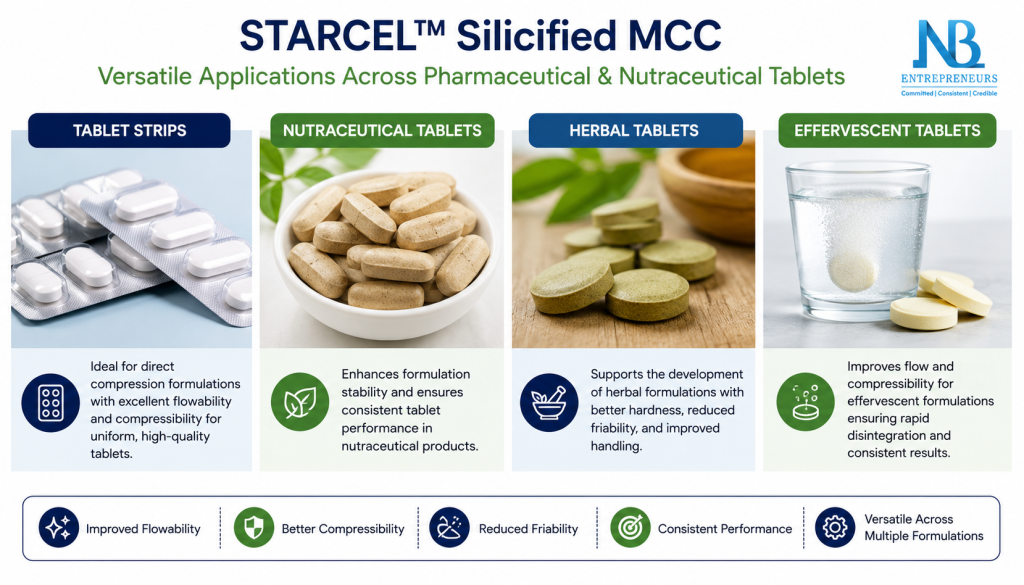
Applications of Silicified MCC
Silicified MCC is one of the functional pharmaceutical excipients used in solid oral dosage formulations.
Direct-Compression Tablets
SMCC is particularly relevant to direct-compression formulations where powder flow and compactibility are important.
Pharmaceutical Tablets
It can be used as a functional excipient in a range of pharmaceutical tablet formulations, depending on formulation requirements.
Nutraceutical Tablets
SMCC may also be evaluated in nutraceutical and dietary supplement formulations where tablet manufacturability and mechanical properties are important.
Herbal and Botanical Tablets
Formulators working with herbal ingredients can consider SMCC when suitable flow and compression characteristics are required.
High-Speed Tablet Manufacturing
For high-throughput tablet production, powder flow, die filling, and compression behavior become increasingly important. Suitable SMCC grades can be evaluated as part of the formulation-development process.
When Should Formulators Consider Silicified MCC?
SMCC may be worth evaluating when a formulation presents challenges such as:
- Poor powder flow
- Inconsistent die filling
- Difficult direct compression
- Insufficient compactibility
- Tablet-strength challenges
- Processing issues during high-speed tableting
However, excipient selection should always be based on formulation-specific testing.
Factors such as API properties, excipient concentration, particle-size characteristics, moisture sensitivity, compression force, tablet press conditions, and target tablet properties should be evaluated during formulation development.
How to Select the Right Silicified MCC Grade?
Selecting an SMCC grade should go beyond simply choosing a material based on its name.
Formulators should consider:
Formulation Requirements
Determine whether the primary challenge relates to flow, compression, compactibility, tablet strength, or another formulation property.
API Characteristics
API particle size, dose, flow properties, compressibility, moisture sensitivity, and loading can influence excipient selection.
Manufacturing Process
Consider whether the formulation uses direct compression, dry granulation, or another manufacturing process.
Target Tablet Properties
Evaluate requirements for:
- Tablet hardness
- Friability
- Disintegration
- Dissolution
- Weight variation
- Content uniformity
Excipient Grade
Different grades may have different physical and functional characteristics. The selected grade should therefore be evaluated against the formulation and manufacturing requirements.
Supplier Documentation
For pharmaceutical applications, manufacturers should also evaluate relevant specifications, analytical documentation, regulatory information, and quality requirements before selecting an excipient.
Alos check the FDA guidance and regulatory information
Silicified MCC in Direct Compression
Direct compression is widely used in tablet manufacturing because it can simplify the manufacturing process. However, successful direct compression depends heavily on the flow and compaction properties of the selected excipients.
A suitable direct-compression excipient should provide an appropriate balance of:
Flowability + Compressibility + Compactibility + Tablet Performance
SMCC can be considered when a formulation requires improved powder handling while retaining the compression properties associated with MCC.
The final performance will depend on the complete formulation and manufacturing process rather than the excipient alone.
Silicified MCC for Pharmaceutical Formulation Development
During formulation development, SMCC can be evaluated alongside other commonly used excipients.
Typical evaluation parameters may include:
- Bulk density
- Tapped density
- Flow properties
- Compressibility
- Compactibility
- Particle-size distribution
- Moisture content
- Tablet hardness
- Friability
- Disintegration
- Dissolution
Comparative formulation trials can help determine whether SMCC provides the desired performance for a specific API and manufacturing process.
Frequently Asked Questions About Silicified Microcrystalline Cellulose
Q1. What is Silicified Microcrystalline Cellulose?
Silicified Microcrystalline Cellulose is a co-processed excipient made from Microcrystalline Cellulose and Colloidal Silicon Dioxide. It is used to support powder flow, compression, compactibility, and tablet manufacturing performance.
Q2. What is Silicified MCC used for?
Silicified MCC is primarily used in solid oral dosage formulations, particularly tablets and direct-compression applications where flow and compression properties are important.
Q3. What is the difference between MCC and Silicified MCC?
MCC consists primarily of Microcrystalline Cellulose, while Silicified MCC combines MCC with Colloidal Silicon Dioxide through co-processing. SMCC is designed to provide a combination of MCC’s compression properties with improved powder-flow characteristics.
Q4. Is Silicified MCC suitable for direct compression?
Yes. Silicified MCC is commonly considered for direct-compression formulations because of its combination of flowability, compressibility, and compactibility characteristics. Suitability should be confirmed through formulation-specific testing.
Q5. Can Silicified MCC improve powder flow?
The incorporation of Colloidal Silicon Dioxide can improve the flow characteristics of MCC-based excipients. Actual performance depends on the grade and formulation.
Q6. How do I choose an SMCC grade?
Grade selection should consider API properties, formulation composition, manufacturing process, flow requirements, compression behavior, target tablet properties, and applicable quality specifications.
Q7. Is Silicified MCC suitable for nutraceutical tablets?
SMCC can be evaluated for nutraceutical and dietary supplement tablets where suitable powder handling and compression characteristics are required.
Choosing a Silicified MCC for Your Formulation
Choosing the right excipient is an important part of pharmaceutical formulation development. Rather than selecting an excipient based on a single property, formulators should consider the complete formulation and manufacturing process.
If you are evaluating commercial Silicified MCC for pharmaceutical or nutraceutical applications, explore STARCEL™ Silicified Microcrystalline Cellulose from NB Entrepreneurs for available grades, technical specifications, packaging information, and product enquiry options.
Explore STARCEL™ Silicified MCC
Conclusion
Silicified Microcrystalline Cellulose is a co-processed pharmaceutical excipient designed to provide a useful balance of powder-flow and compression characteristics. By combining Microcrystalline Cellulose with Colloidal Silicon Dioxide, SMCC can support direct-compression and other tablet manufacturing applications.
Its suitability depends on factors such as API characteristics, formulation composition, manufacturing process, excipient grade, and desired tablet properties. For this reason, formulation-specific evaluation remains essential when selecting an SMCC grade.
For pharmaceutical manufacturers and formulators, understanding the functional properties of Silicified MCC can help in making more informed excipient-selection decisions and developing efficient, consistent tablet manufacturing processes.
| Need a reliable Silicified MCC Manufacturer for direct compression formulations? Contact NB Entrepreneurs to explore STARCEL™ and other advanced pharmaceutical excipients. Contact Us: +91 7030058467 | Email us: info@nb-cellulose.com Become a Partner | Request a Quote |


Hello,
This is Sree out of Canada. We are looking for USP grade SMCC. Are you able to provide? Is it possible to ship a sample of 1KG or 2KG? Let me know your thoughts. Best/Sree
Thank you for reaching out to us, Sree.
We appreciate your interest in our USP-grade SMCC.
Our team will review your requirements and get in touch with you shortly regarding sample availability and further details.