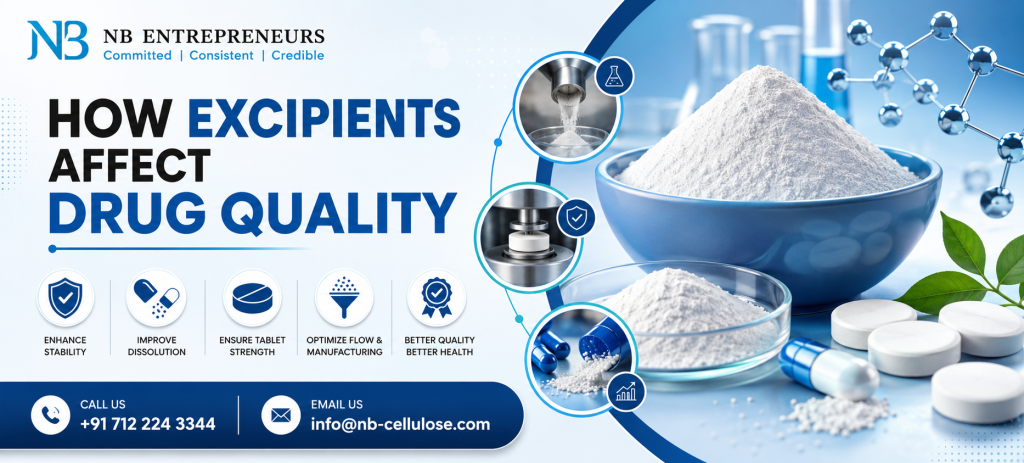
How Excipients Affect Drug Quality: A Complete Pharmaceutical Guide
Excipients affect drug quality by influencing stability, dissolution, bioavailability, manufacturability, tablet performance, and overall product consistency. Their physical and chemical properties, purity, variability, and compatibility with the API can directly influence critical quality attributes of the finished pharmaceutical product.
Nowadays, these quality, well-being, and viability of the items are the prime necessities. Subsequently, the regulatory bodies are concentrating on implementing quality by design (QbD), which is a science-based approach for better product and process understanding by reducing process variability and empowering process-control procedures.
How Excipients Affect Drug Quality?
The impact of pharmaceutical excipients can be understood through six important areas.
1. Drug Stability
Excipient properties can influence the chemical and physical stability of an API during manufacturing and storage.
Factors such as moisture, temperature, oxidation, impurities, pH, and API–excipient compatibility can affect degradation and shelf life.
Before selecting an excipient, formulators should evaluate whether its properties are compatible with the API and the intended storage conditions.
Key consideration: A pharmaceutically suitable excipient is not automatically suitable for every API.
2. Dissolution and Drug Release
Excipients can influence how quickly a tablet disintegrates and how the API becomes available for dissolution.
For example, disintegrants help tablets break apart after administration, while binders and other excipients can influence tablet structure and release characteristics.
The right combination can help control:
- Disintegration time
- Dissolution rate
- Drug-release behavior
- Overall formulation performance
This makes excipient selection particularly important for immediate-release and modified-release formulations.
3. Tablet Strength and Mechanical Performance
A tablet needs enough mechanical strength to survive compression, handling, packaging, transportation, and storage.
Microcrystalline Cellulose (MCC) is widely used in tablet formulations because of its binding and compressibility properties. Silicified Microcrystalline Cellulose (SMCC) can be considered when a formulation also requires improved powder-flow characteristics.
The objective is not simply to make a harder tablet. The formulation must achieve the right balance between:
Compressibility + hardness + friability + disintegration
This balance is particularly important for efficient tablet manufacturing.
4. Powder Flow and Manufacturability
Poor powder flow can create problems during tablet production, including inconsistent die filling, weight variation, segregation, and processing interruptions.
Excipient characteristics such as:
- Particle size
- Particle shape
- Bulk density
- Moisture
- Flowability
- Compressibility
can influence manufacturing performance.
For direct compression, this becomes even more important because the powder blend must flow and compress effectively without a separate granulation step.
Better excipient functionality can mean more consistent and efficient tablet production.
5. Content Uniformity
Every tablet should contain the intended amount of API. Excipient properties can influence the uniformity of the final blend through their effects on mixing and segregation.
Differences in particle size, density, shape, and flow behavior between the API and excipients may increase the risk of segregation.
Therefore, formulators should evaluate:
- API and excipient particle-size distribution
- Density differences
- Flow characteristics
- Blend behavior
- Excipient consistency between batches
Consistent raw materials can support better batch-to-batch reproducibility.
6. Bio availability and Drug Performance
Excipients can influence drug performance by affecting disintegration, dissolution, solubility, and release.
However, their impact depends on the API, excipient type, concentration, dosage form, and formulation design.
This is why excipient selection should be based on functionality and API compatibility, rather than selecting an excipient simply because it is commonly used.
Why Excipient Quality Matters?
Two excipients may have the same compendial name but still show differences in physical properties that can influence processing and formulation performance.
Important quality attributes may include:
| Excipient Attribute | Potential Formulation Impact |
|---|---|
| Particle size | Flow, blending and dissolution |
| Moisture | Stability and compression |
| Bulk density | Die filling and tablet weight |
| Flowability | Manufacturing consistency |
| Compressibility | Tablet strength |
| Purity | Stability and API compatibility |
For this reason, consistent excipient specifications and reliable quality control are essential for pharmaceutical manufacturing.
How Quality by Design Helps Control Excipient Quality?
Quality by Design (QbD) is a systematic approach used in pharmaceutical development to understand how formulation materials and manufacturing processes can influence the quality of the finished drug product.
When selecting pharmaceutical excipients, QbD helps formulators identify key material properties, assess their potential impact on product quality, and establish appropriate controls to ensure consistent manufacturing.
Key QbD Elements in Excipient Selection
| QbD Element | Importance in Excipient Selection |
|---|---|
| Quality Target Product Profile (QTPP) | Defines the intended quality, dosage form, performance, and stability requirements of the finished product. |
| Critical Quality Attributes (CQAs) | Identifies product characteristics such as strength, purity, dissolution, and stability that must meet predefined requirements. |
| Critical Material Attributes (CMAs) | Evaluates important excipient properties such as particle size, moisture content, density, flowability, and compressibility. |
| Critical Process Parameters (CPPs) | Identifies manufacturing parameters that can influence the CQAs of the finished product. |
| Design Space | Establishes acceptable combinations of material properties and process conditions that can consistently deliver the desired quality. |
| Design of Experiments (DoE) | Helps determine how formulation and manufacturing variables interact and influence product performance. |
Why Does QbD Matter for Pharmaceutical Excipients?
Excipient variability can influence powder flow, blending, compressibility, tablet hardness, disintegration, dissolution, and manufacturing consistency. A QbD approach helps manufacturers understand these relationships before they become formulation or production problems.
For example, variations in particle size or moisture content can affect powder flow and compression behavior. Similarly, differences in excipient functionality may influence tablet disintegration and dissolution.
Therefore, evaluating excipients based on their critical material attributes, functionality, compatibility, and batch-to-batch consistency can support more predictable formulation development and reliable pharmaceutical manufacturing.
Important Excipient Attributes to Evaluate
When choosing an excipient, formulators should consider:
- Particle size: Can influence flow, blending, compression, and dissolution.
- Moisture content: May affect stability, flow, and tablet compression.
- Bulk and tapped density: Can influence die filling and tablet weight.
- Flowability: Supports consistent powder handling and manufacturing.
- Compressibility: Important for achieving suitable tablet strength.
- Purity and impurity profile: Relevant to API compatibility and product stability.
- Batch-to-batch consistency: Helps maintain reproducible formulation performance.
In short, QbD connects excipient properties with finished-product quality. Understanding these relationships helps pharmaceutical manufacturers select suitable excipients and build more robust, consistent formulations.
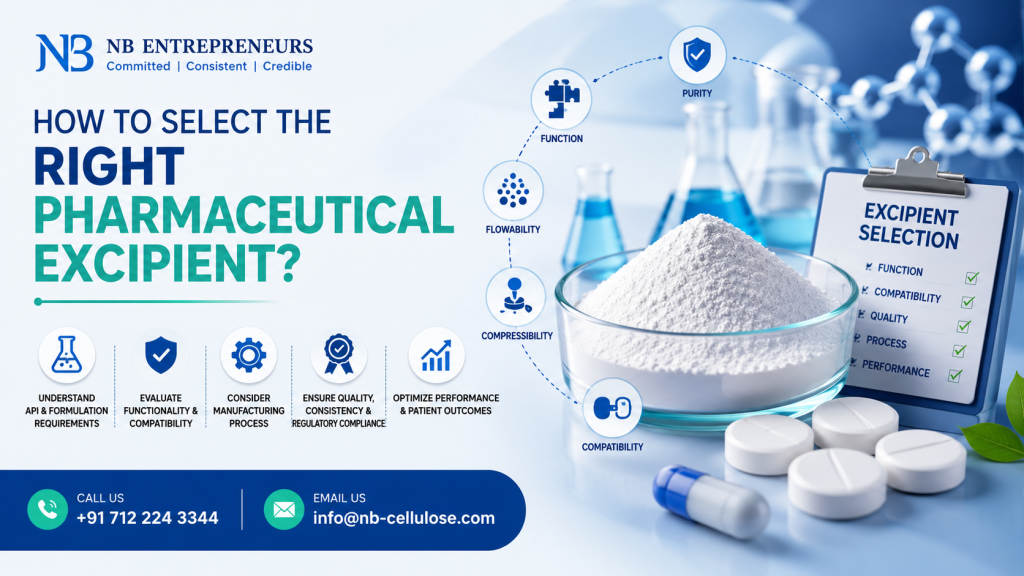
How to Select the Right Pharmaceutical Excipient?
A practical excipient-selection approach should consider:
API properties → Desired dosage form → Manufacturing process → Excipient functionality → Compatibility → Quality requirements
Before final selection, formulators should assess the API’s dose, solubility, moisture sensitivity, particle characteristics, stability, and compressibility, as well as the intended manufacturing method.
For direct compression, for example, flowability and compressibility become particularly important.
Learn more about selecting excipients for tablet formulation and the role different excipients play in pharmaceutical manufacturing.
Co-Processed Excipients for Improved Formulation Performance
Modern formulations increasingly use co-processed excipients to combine complementary functional properties.
They may help improve:
- Powder flow
- Compressibility
- Blend uniformity
- Tablet strength
- Manufacturing efficiency
For formulators comparing conventional and multifunctional excipients, understanding the differences between co-processed and single excipients can help identify the most suitable approach for a formulation.
Why Choose NB Entrepreneurs for Pharmaceutical Excipients?
NB Entrepreneurs, with 49+ years of experience, offers a range of pharmaceutical excipients designed to support consistent formulation and manufacturing performance.
Our portfolio includes:
- Microcrystalline Cellulose
- Silicified Microcrystalline Cellulose
- MCC with Sodium CMC
- Sodium Starch Glycolate
- Pregelatinized Starch
- Mannitol
- Specialty excipients
We support pharmaceutical businesses in India, the USA, the UK, and global markets with quality-focused excipient solutions and reliable supply.
Frequently Asked Questions
How do excipients affect drug quality?
Excipients can affect drug stability, dissolution, tablet strength, content uniformity, manufacturability, and overall product performance.
Why is API–excipient compatibility important?
Compatibility helps minimize unwanted physical or chemical interactions that could affect API stability, dissolution, or finished-product quality.
Which excipients improve tablet strength?
Excipients such as Microcrystalline Cellulose can provide binding and compressibility properties that support tablet strength and manufacturing performance.
Why are excipient physical properties important?
Properties such as particle size, moisture, density, flowability, and compressibility can influence blending, compression, tablet quality, and manufacturing consistency.
Need Reliable Pharmaceutical Excipients?
Looking for high-quality pharmaceutical excipients for your formulation or manufacturing requirements?
Partner with NB Entrepreneurs for reliable excipient solutions backed by 49+ years of experience, serving pharmaceutical manufacturers in the USA, UK, India, and global markets.
📧 info@nb-cellulose.com
📞 +91 7030058467
Get a Quote for Pharmaceutical Excipients | Become a Pharmaceutical Excipient Partner

