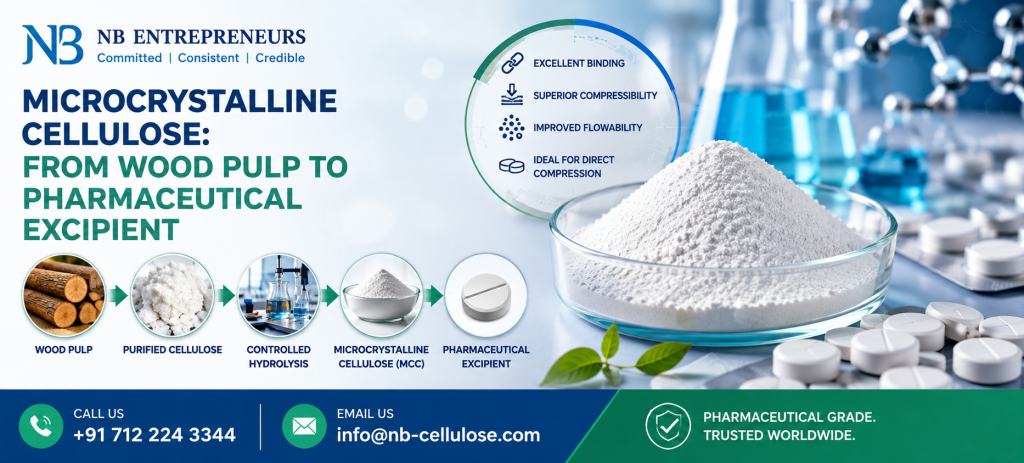
Microcrystalline Cellulose: From Wood Pulp to Pharmaceutical Excipient
Microcrystalline Cellulose (MCC) is one of the most widely used pharmaceutical excipients for tablet manufacturing. But MCC does not simply come from wood pulp and go directly into a tablet. Its transformation involves controlled processing that gives cellulose the physical and functional properties required for pharmaceutical applications.
From cellulose purification and controlled hydrolysis to particle engineering and grade selection, each stage can influence the final performance of MCC in a formulation.
This article explores the journey of MCC from cellulose source to pharmaceutical excipient and explains why its material properties matter in tablet manufacturing.
From Cellulose Source to Pharmaceutical-Grade MCC
Cellulose is a naturally occurring polymer found in plant-based materials. High-purity cellulose sources, including selected wood pulps, can be processed to produce MCC suitable for pharmaceutical applications.
The general manufacturing concept can be represented as:
Purified Cellulose → Controlled Hydrolysis → Washing & Purification → Drying → Particle Engineering → Pharmaceutical-Grade MCC
During processing, controlled hydrolysis reduces the degree of polymerization of cellulose while retaining its crystalline structure. The resulting material is then processed to achieve the physical characteristics required for different MCC grades.
The final material is evaluated against appropriate quality specifications before being supplied for pharmaceutical formulation.
How Is Microcrystalline Cellulose Made?
The manufacturing process of Microcrystalline Cellulose (MCC) involves several important stages.
1. Selection and Purification of Cellulose
The process begins with a suitable high-purity cellulose source. Purification is important because the quality of the starting material can influence the characteristics of the final MCC.
2. Controlled Hydrolysis
The purified cellulose undergoes controlled hydrolysis to partially depolymerize the cellulose chains.
This controlled treatment helps produce the characteristic structure and functionality associated with MCC.
3. Washing and Purification
After hydrolysis, the material is washed and processed to remove unwanted soluble components and achieve the required level of purity.
4. Drying and Particle Engineering
The material is subsequently dried and processed to obtain the desired physical characteristics, including particle-size distribution and density.
These characteristics can influence how MCC behaves during blending, powder flow, compression, and tablet manufacturing.
5. Quality Evaluation
The finished MCC is evaluated against relevant specifications and quality requirements to ensure consistency between batches.
The manufacturing process therefore plays an important role in determining how an MCC grade performs in a pharmaceutical formulation.
Key Material Properties of MCC
MCC is valued in pharmaceutical manufacturing because of its combination of physical and functional properties.
Important properties include:
- Compressibility – supports tablet formation under compression.
- Binding functionality – helps particles form cohesive tablets.
- Flow characteristics – influence powder handling and die filling.
- Particle size – can affect blending and processing behavior.
- Bulk density may influence formulation volume and die filling.
- Moisture content – can affect processing and formulation stability.
- Porosity – can contribute to liquid penetration and tablet disintegration.
However, these properties can vary between grades. Therefore, MCC should be selected according to formulation and manufacturing requirements rather than treated as a one-size-fits-all excipient.
Why Is MCC Used in Pharmaceutical Tablets?
MCC is particularly useful in tablet formulations because it can perform multiple functions within a formulation.
It can contribute to:
- Tablet binding
- Compressibility
- Tablet strength
- Powder handling
- Direct compression
- Formulation robustness
For formulators, this versatility can make MCC a useful option when developing tablets that require suitable mechanical strength without unnecessarily complex processing.
The appropriate MCC grade, however, depends on factors such as API properties, formulation composition, manufacturing method, and required tablet performance.
MCC in Direct Compression Tablet Manufacturing
Direct compression requires the formulation blend to possess suitable flowability, compressibility, and compactability because the powder is compressed directly into tablets without a conventional wet-granulation step.
MCC is commonly considered for direct-compression formulations because of its compressibility and binding functionality.
However, successful direct compression depends on the complete formulation, not MCC alone. API properties, particle-size distribution, lubricant concentration, moisture, other excipients, and compression conditions can all influence tablet performance.
Understanding the different stages of tablet processing helps formulators select excipients that deliver consistent manufacturing and tablet performance.
Why Does MCC Grade Matter?
Different MCC grades can exhibit different physical characteristics, particularly in areas such as particle size, density, and powder flow.
These differences can affect:
- Powder flow
- Die filling
- Blend uniformity
- Compression behavior
- Tablet weight consistency
- Tablet mechanical strength
Therefore, choosing an MCC grade should be based on the specific formulation and manufacturing requirements.
For example, a formulation experiencing powder-flow challenges may require a different MCC grade or excipient strategy than a formulation primarily focused on compression performance.
MCC PH 101 vs PH 102
PH 101 and PH 102 are commonly discussed MCC grades with different particle characteristics that can influence powder handling and formulation performance.
How to Select the Right MCC for a Formulation
Choosing MCC should begin with the formulation’s requirements rather than simply selecting the most commonly used grade.
Consider:
API Characteristics
Evaluate dose, particle properties, moisture sensitivity, solubility, and compatibility.
Manufacturing Process
Determine whether the formulation uses direct compression, dry granulation, or another manufacturing approach.
Powder Performance
Consider flowability, density, particle size, and blending behavior.
Compression Requirements
Assess the required tablet hardness, friability, and mechanical strength.
Finished-Product Performance
Consider how the excipient may influence disintegration, dissolution, and overall tablet performance.
MCC and Modern Pharmaceutical Formulation
As pharmaceutical manufacturers continue to optimize tablet manufacturing, excipient selection is increasingly focused on functionality, consistency, and process performance.
MCC remains valuable because it combines several useful characteristics in a single excipient. However, formulation developers should evaluate its critical material attributes, compatibility, grade characteristics, and intended application before making a final selection.
For formulations requiring specific flow and compression characteristics, Silicified Microcrystalline Cellulose (SMCC) may also be considered as an alternative excipient approach.
Pharmaceutical-Grade MCC from NB Entrepreneurs
NB Entrepreneurs supplies pharmaceutical excipients for formulation and manufacturing applications, with 49+ years of industry experience.
Our portfolio includes Microcrystalline Cellulose, Silicified Microcrystalline Cellulose, MCC with Sodium CMC, and other pharmaceutical excipients designed for diverse formulation requirements.
We support pharmaceutical businesses across India, the USA, the UK, and international markets.
Looking for Pharmaceutical-Grade MCC?
Whether you are developing a new tablet formulation or evaluating excipient options for commercial manufacturing, our team can help you explore suitable pharmaceutical excipient solutions.

